Cameras for a site that has no power, no network and no staff at night
A construction site is the worst case for CCTV: nothing to plug into, no cable run to the gate, plant worth stealing sitting in the dark, and a fence line that moves every month. We build one platform for that job — a solar tower with its own storage and an alarm that makes something happen — in six camera bodies on two arrays. Thirteen builds: eleven on a pole, two on a tow bar.
30× heads, one to four — the reach builds
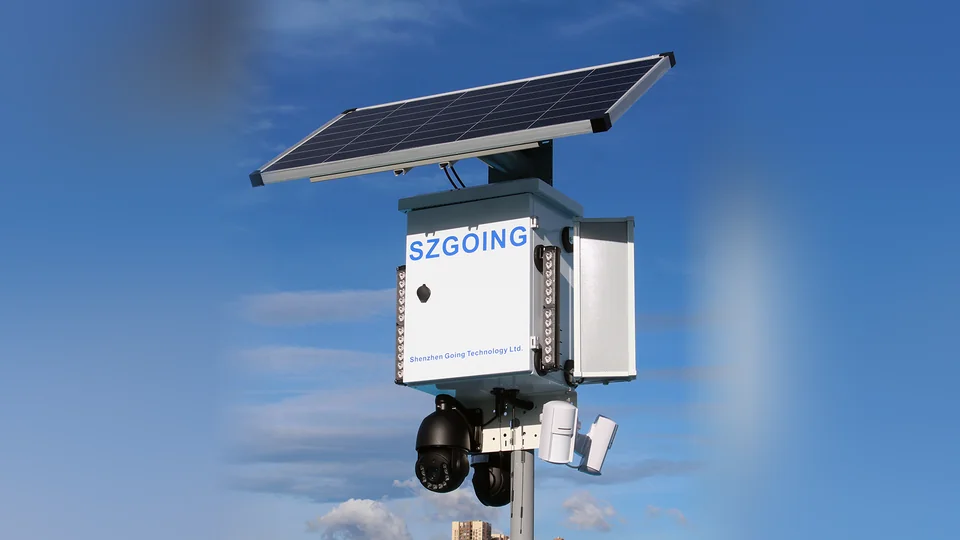
BS200 solar 4G PTZ site kit
Two 8 MP cameras with 30x optical zoom on one pole, fed by 200 W of panel, recorded to a 1 TB Hikvision NVR inside the box. Flat speaker array plus red-blue light answers the intrusion.
- 2 × 30x PTZ
- 100 m IR
- 1 TB on site
- Two-way talk
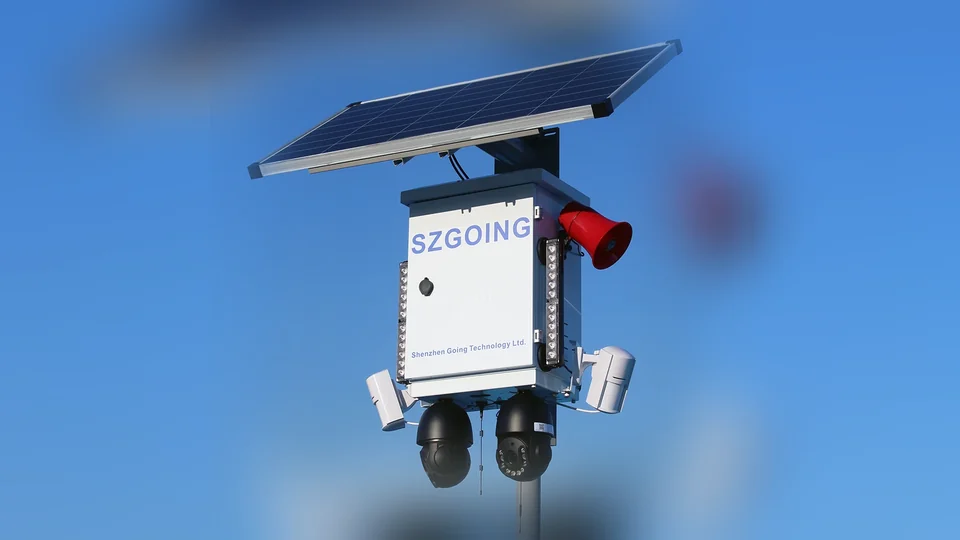
BS200-SA solar 4G PTZ site kit
The same tower in its -SA build: a red horn siren on the box face, a data SIM fitted at the factory and the 4G module set to the band plan of the destination. Ships DDP to your gate.
- Horn siren
- SIM fitted
- Band build
- DDP 3–4 weeks
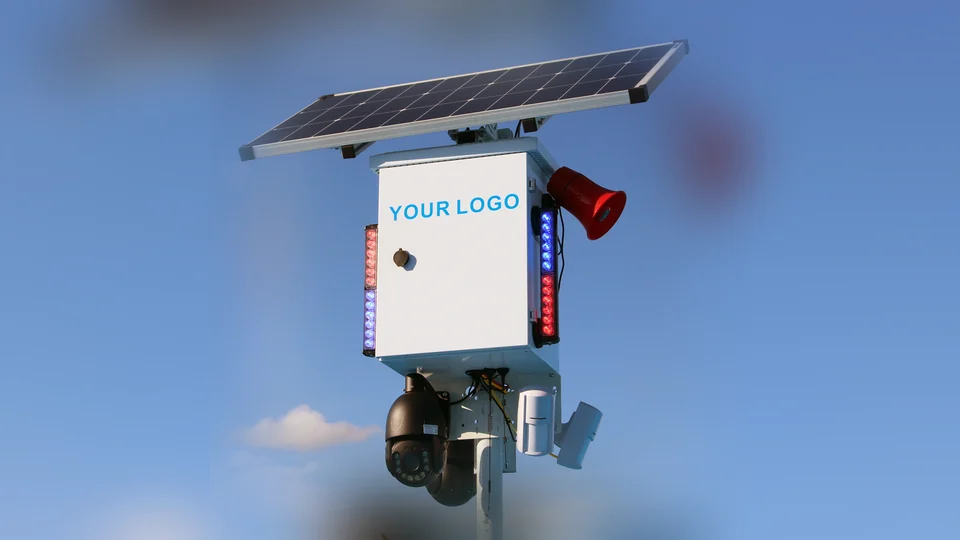
BS200 PTZ alarm site kit
The deterrent tier: horn, two red-blue bars and a laser module on request, with 96 mm of glass behind it. The laser puts a visible line on the ground at the far fence.
- Horn + bars
- Laser option
- 100 m IR
- 62 kg
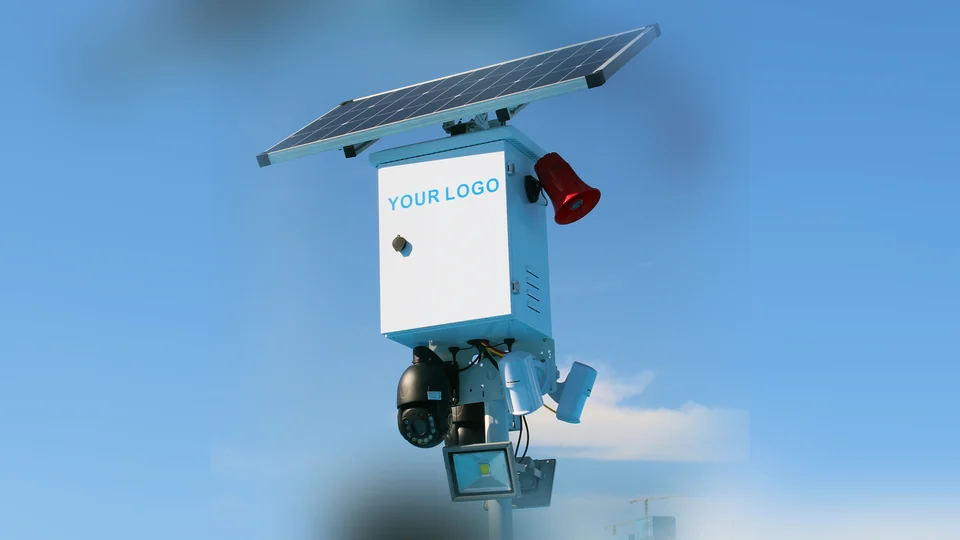
BS200 PTZ flood site kit
Zoom for the fence, 40 W of LED for the ground in front of it, in a blue-grey housing. The light keeps the near field in colour; the heads keep working past its reach.
- 2 × 20 W LED
- 30x zoom
- Blue housing
- RAL on request
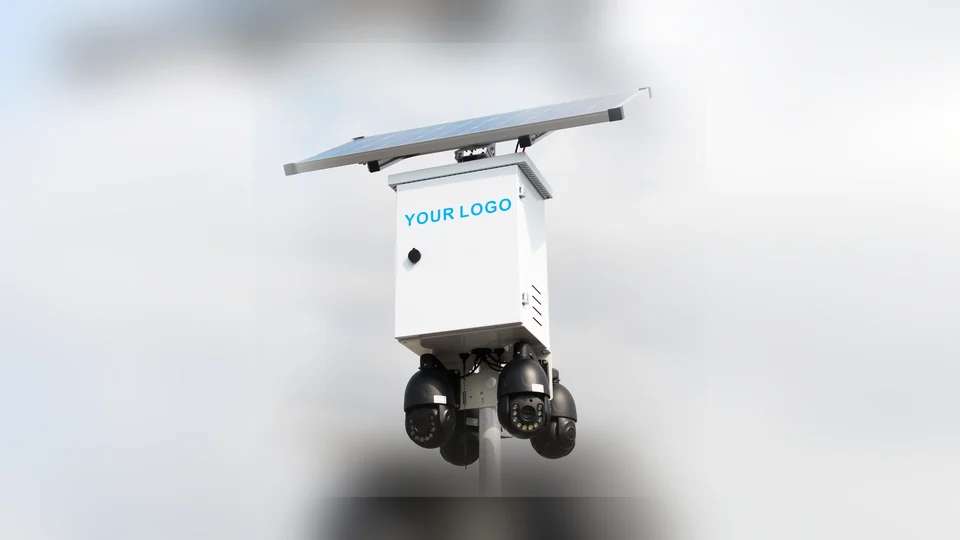
BS200 quad PTZ site kit
Four 30x heads on one box and one recorder, which is the ceiling: four channels, four ports, no spare. Buy it for four directions that each need their own 96 mm.
- 4 × 30x PTZ
- All 4 channels
- Four presets
- 62 kg
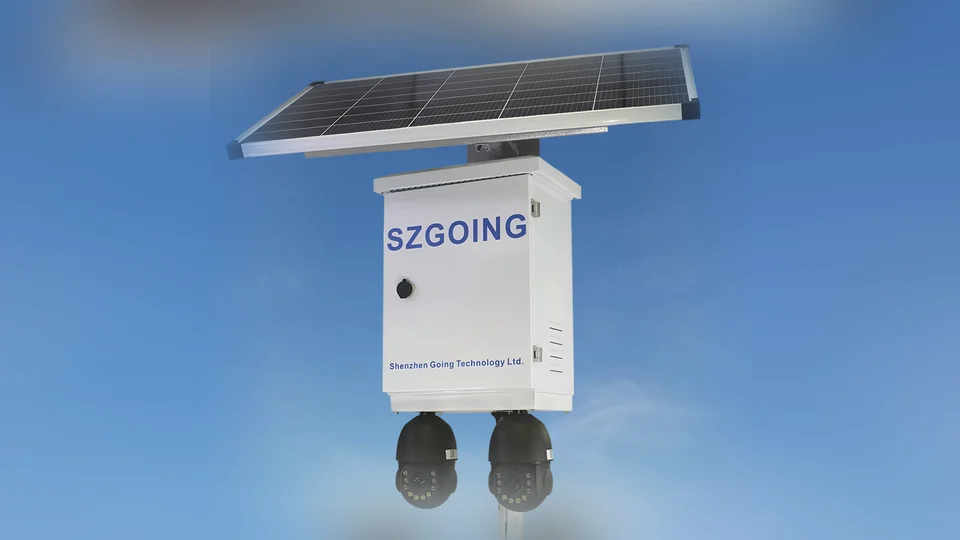
BS200 dual card site kit
The same two heads with the recorder taken out: 256 GB in each camera, Video Link instead of Hik-Connect. Six days per head, and one dead card costs one view.
- 2 × 256 GB cards
- No NVR
- 30x zoom
- 512 GB total
Three fixed lenses — the coverage builds
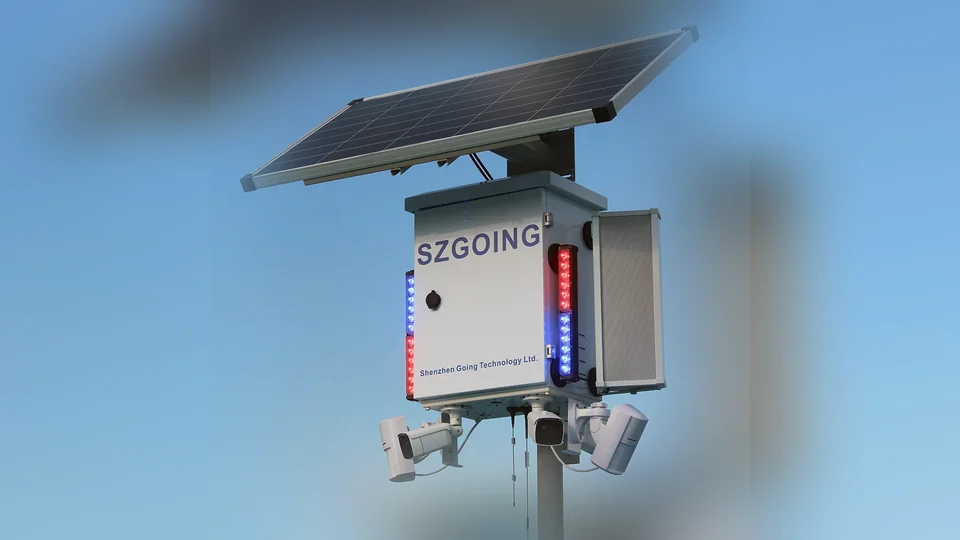
BS200-A3 three-camera site kit
Three 8 MP bullets on 2.8 mm lenses, 120° apart, holding one plate with no motors to seize or presets to drift. Speaker array with two-way talk, plus two red-blue bars.
- 3 × 8 MP
- 360° plate
- No moving parts
- Spare channel
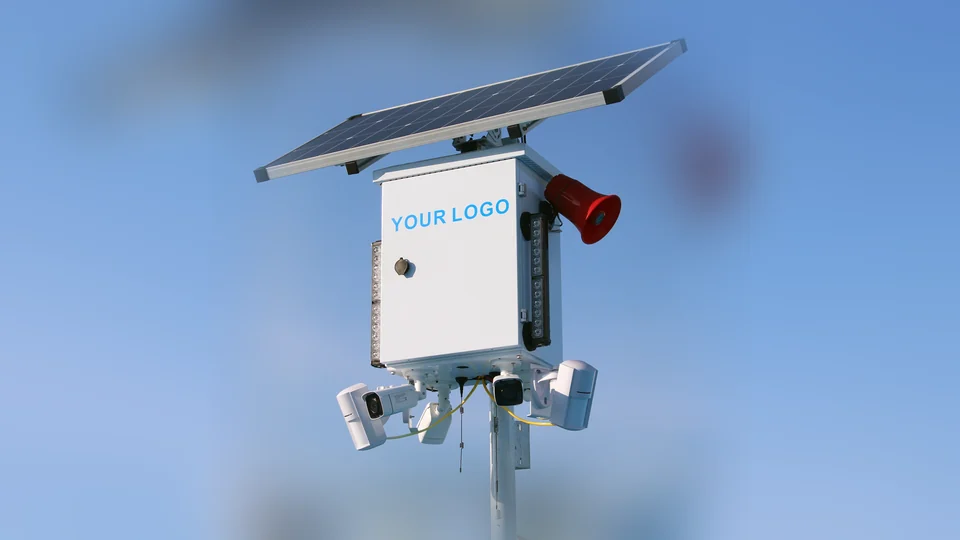
BS200-A3 alarm site kit
The same three cameras with a red horn siren instead of the speaker array. One-way, louder outdoors and cheaper — the build for a site nobody is talking to at 02:00.
- Horn siren
- 2 bars
- 3 × 8 MP
- 60 kg
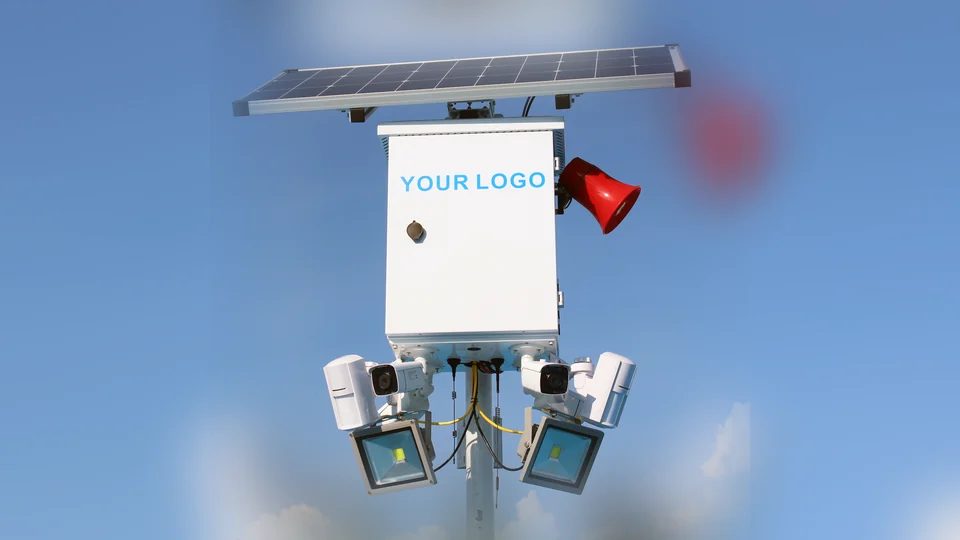
BS200-A3 flood site kit
Lit instead of sounded: two 20 W LED panels on the alarm relay keep the approach in colour to about thirty metres. The horn stays, the bars go.
- 2 × 20 W LED
- Colour near field
- 3 × 8 MP
- 54 kg
One 100 W panel — the builds you carry up
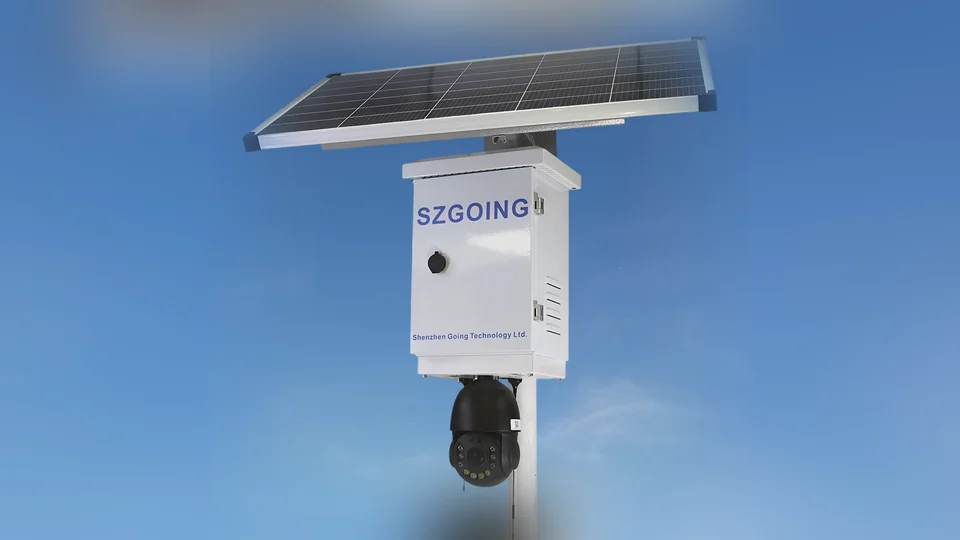
BS100 PTZ site kit
Half the tower for the site with one direction: one 30x head, one 100 W panel, 128 GB inside the camera. Two people and a ladder, no lifting gear.
- 1 × 30x PTZ
- 100 W panel
- 128 GB card
- 40–50 Ah
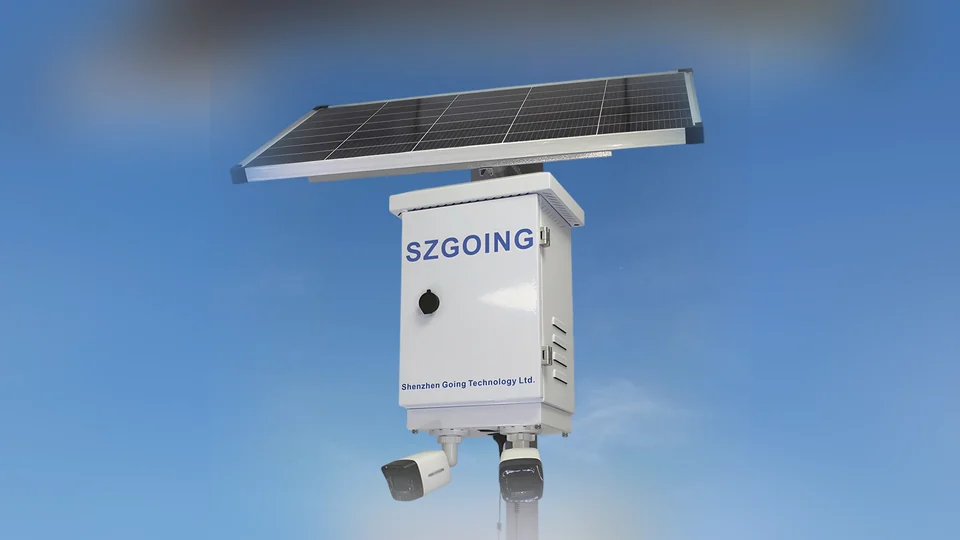
CS100 two-camera site kit
Two fixed 105° lenses on the same light pole, aimed once and left. Nothing in the head moves, so the first second of an incident is always recorded.
- 2 × 8 MP bullet
- No motors
- 128 GB each
- Hik-Connect
The two you tow — 890 W and 900 W on four legs
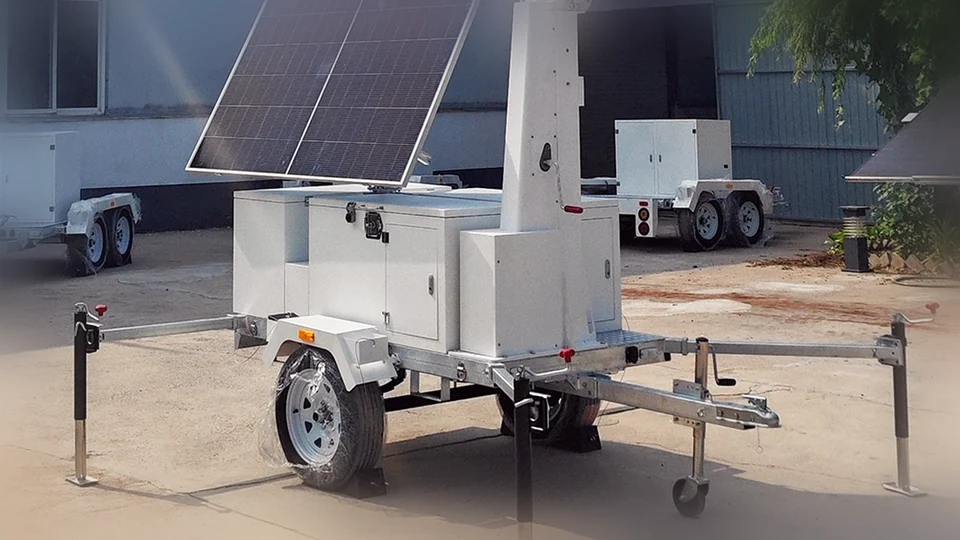
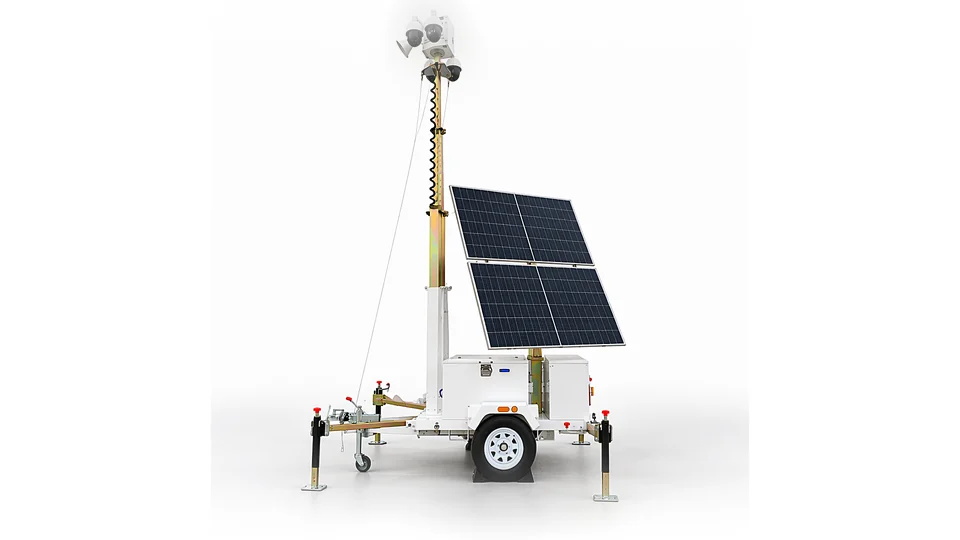
GT70480M solar trailer
890 W of panel and 7,200 Wh of gel on a single-axle trailer, with a hand-cranked 6 m mast and four legs instead of a pole. It is the same job as the towers above, for the site that moves.
- 890 W array
- 6 m mast
- 4 cameras
- 2 TB SSD
T2 solar trailer
The same trailer with four 30x heads instead of one zoom and three wide angles: every side of the compound can be read at 100 m, paid for with 900 W of panel and 7,200 Wh of gel.
- 4 × 30x PTZ
- 900 W array
- 1.3 kWh a day
- 2 TB SSD
What ships in one box
- 1 to 4 × PTZ head with 30x zoom, or 3 × fixed 8 MP bullet — depending on the body
- 2 × 100 W panel on an aluminium bracket
- Equipment box: 4G/WiFi router, 1 TB NVR, 20 A charge controller
- Alarm: horn siren, speaker array, red-blue bars, or 2 × 20 W LED flood
- 2 × outdoor PIR, 4G and WiFi antennas, SIM with 100 MB test data
- Pole adapter for 60 mm poles, install tool kit
The two 100 W builds ship one panel, one pole adapter and a card in each camera instead of a recorder in the box. Not included on the pole builds: the pole and the 12 V battery. Both are cheaper to buy locally than to ship, and the kit takes any 12 V pack — a 12.8 V 100 Ah LiFePO4 is the match we quote on 200 W builds, and 40–50 Ah on the 100 W ones. The flood build is quoted at 54 kg without the pole adapter; the others ship at 60–62 kg with it. The trailer arrives complete — 890 W of panel, 6 m mast, four legs and its own 7,200 Wh bank — because nothing about it is bought locally.
Which of the thirteen builds
Three questions, in this order: what array, what body, then what answer. The 200 W builds all carry a recorder and the Hik-Connect app unless you take the card version; the two 100 W builds carry one panel and record inside the cameras, which is what makes them light enough to install without help. Two of the thirteen are not a pole at all — the trailers.
- Array first. One 100 W panel and a card in the camera is a two-person install on a ladder; 200 W and a recorder in the box is a heavier lift and a longer archive. The 100 W builds exist for a site that moves, the 200 W builds for a site that has to answer for a fortnight of footage.
- Body. Fixed lenses hold a whole compound and have nothing in the head that wears out. A single 30x head reads a plate at a hundred metres but can only be in one place; two or four of them cover several directions with reach. Coverage or reach — very few sites need both from one pole, and the ones that do buy two towers.
- Archive. A 1 TB recorder gives one timeline and eleven days across two heads; 256 GB in each camera gives six days each and survives a single card failure. If somebody watches a wall of screens, take the recorder.
- Answer. A speaker array talks back to a driver at the gate. A horn siren blunts the alarm across an open compound and cannot be talked to. Red-blue bars are seen from the office and by the neighbours; 20 W LED panels put colour into the picture for the twenty metres where a person actually walks; a laser is a visible line at the feet of somebody already at the fence.
- Move. If the camera has to follow the work, none of the above decides it: the trailer is the only build here that is not bolted to a pole you leave behind. It costs more and it needs a tow vehicle, and on a site that shifts twice a year that is the whole argument.
If you are buying against a forwarder, take a -FL build. If the crate has to land and work the same day, take a -SA build with the SIM fitted and the band plan set. Both are on this page.
| Build | Cameras | Alarm and light | Infrared | Weight | Best for |
|---|---|---|---|---|---|
| BS200 (-FL) | 2 × PTZ, 8 MP | Speaker array, 2 red-blue bars | 100 m | 62 kg | Gate and long boundary, two-way talk |
| BS200-SA | 2 × PTZ, 8 MP | Horn siren, 2 bars; SIM fitted | 100 m | 62 kg | Lands and works the same day |
| BS200 PTZ alarm | 2 × PTZ, 8 MP | Horn, 2 bars, optional laser | 100 m | 62 kg | The far fence, at night, with nobody watching |
| BS200 PTZ flood | 2 × PTZ, 8 MP | Horn, 2 × 20 W LED; blue housing | 100 m | 62 kg | A manned screen, and a site with a colour |
| BS200 quad PTZ | 4 × PTZ, 8 MP | Horn, 2 bars; all four channels used | 100 m | 62 kg | Four directions, each needing its own zoom |
| BS200-A3 | 3 × bullet, 8 MP | Speaker array, 2 bars | 25–30 m | 60 kg | Compound and fence line, two-way talk |
| BS200-A3 alarm | 3 × bullet, 8 MP | Horn siren, 2 bars | 25–30 m | 60 kg | Compound, where the alarm has to carry |
| BS200-A3 flood | 3 × bullet, 8 MP | Horn, 2 × 20 W LED | 25–30 m | 54 kg | Compound lit for the camera and the guard |
| BS200 dual card | 2 × PTZ, 8 MP | No recorder; 2 × 256 GB in the cameras | 100 m | 62 kg | Two heads, checked from a phone, no timeline needed |
| BS100 PTZ | 1 × PTZ, 8 MP | 128 GB in the camera; 100 W array | 100 m | 1 panel | One gate, one approach, one afternoon to install |
| CS100 twin | 2 × bullet, 8 MP | 128 GB each; fixed 105° lenses | 25–30 m | 1 panel | Two directions held permanently, no motors |
| GT70480M trailer | 1 × PTZ + 3 × bullet, 8 MP | 2 red-blue beacons; 2 TB SSD in the box | 25–100 m | Trailer | A site that moves, or a winter nobody watches |
Four things a site install has to survive
A grey week, not a sunny afternoon
The array is sized for the load, not for the brochure photo: 200 W of panel against two zoom cameras and a recorder. If your site is in a low-sun month, the battery is what carries it — which is why we size the pack to your latitude instead of shipping a token one. It is also why the LED flood panels are on the alarm relay rather than on a photocell.
Recording that stays on site
A 1 TB drive in the box means continuous or motion recording without a cloud subscription. Continuous 4G streaming burns data and dies quietly the month the SIM runs out.
Something that answers back
Detection alone moves nobody. A red-blue light and a 120 dB siren that can be triggered from the app does — and it gives the guard time to look at the right camera. Where a person is watching a screen, 40 W of white light answers better than a strobe: it shows them what they are looking at.
Reach or coverage, decided by the job
30x optical zoom at 3.2–96 mm over 360° endless pan reads a number plate at the far fence. Three fixed 2.8 mm lenses hold the whole compound at once instead. Neither is better; a site that needs both usually takes a zoom tower at the gate and a wide tower inside it.
One pole, one afternoon
There is no trench and no cabinet to build. The tower clamps to a pole — 60 mm standard, up to 170 mm on request — and everything above it arrives pre-wired: panel, box, cameras, light and speaker. Two people lift it, one person connects the battery, and the rest is done in the Hik-Connect app. The trailer is the exception to the pole: four legs on the ground, a tow bar, and a hand crank for the mast.
The 4G router picks the strongest local network on its own, so the site does not need a contracts meeting with a carrier before it is watched. When the site moves, the tower comes down with it — the reason we keep the pole out of the kit.
For the specification
Full electrical detail — panel curves, controller rating, band support for your country and the pin-out of the alarm inputs — is on the BS200 kit page, the BS200-SA page, which carries the three 4G band plans we build to, and the BS200-A3 page, which works the coverage arithmetic through in metres and pixels. The four alarm and light builds are specified in full on their own pages: A3 alarm, A3 flood, PTZ alarm and PTZ flood. The two 100 W builds and the recorder-free version carry their own electrical and storage arithmetic: BS100 PTZ, CS100 twin and BS200 dual card. The trailer is specified on its own page, including the tow weight and the mast arithmetic: GT70480M trailer.
Site camera FAQ
What does a site tower need that a normal solar camera does not?
Three things. Enough panel to run zoom motors and an NVR through a grey week, a recorder on site rather than a cloud plan that dies with the SIM balance, and something that makes a person leave — light and a siren, not just a notification nobody sees until the morning.
Do I need power or internet at the site?
No. The kit runs from its own solar array and a 12 V battery, and reaches the internet over a 4G SIM. A data SIM with 100 MB of test data ships in the box, or you can fit your own.
Is the battery or the pole included?
Neither, on the pole builds. Both are expensive to ship across borders and are usually bought locally. The kit accepts any 12 V battery — a 12.8 V 100 Ah LiFePO4 is what we recommend — and the pole adapter clamps to a 60 mm pole, with 170 mm available on request. The trailer is the exception: it ships with its 7,200 Wh gel bank fitted, because a trailer needs the ballast and nobody wants to install four 150 Ah blocks on site.
Can the recording be handed to the client or an insurer?
Yes. Footage sits on a 1 TB drive in the box — 2 TB of SSD on the trailer — so playback, export and clip download do not depend on a subscription. The Hik-Connect app and the free desktop VMS both export clips.
Read next
Solutions by site type — compounds, farms, remote property and vehicle fleets, and what changes between them.
Price a tower for your site
Send the site plan, the pole positions and the power budget you have. You get a bill of materials and a delivered price, not a catalogue page.