BS200-A3 · Construction site · 4G

Three lenses at 120°: coverage that never has to look away

The two PTZ builds answer one question — what is happening at the far gate — and they answer it with 30× of optical glass. This build answers a different one: is anything moving, anywhere, right now. Three fixed 8 MP bullets on 2.8 mm lenses sit 120° apart on the plate, so the tower holds the whole circle at once instead of sweeping it. What that costs is reach: 25 m of infrared, no zoom, and a face that stops being identifiable at about six metres.

  • 3 × 8 MP infrared bullet cameras on 2.8 mm fixed lenses, about 105° each
  • Lenses 120° apart on one plate — 360° with overlap, no pan cycle, no blind interval
  • No pan motor, no slip ring, no belt: nothing to seize, drift or lose a preset
  • 25–30 m infrared — built for the compound, not the far boundary
  • 1 TB Hikvision NVR with four camera ports, CAM4 free; 200 W of panel, 20 A controller
  • 120 dB siren with two-way talk, 2 red-blue bars, 2 PIR inputs; 60 kg as shipped
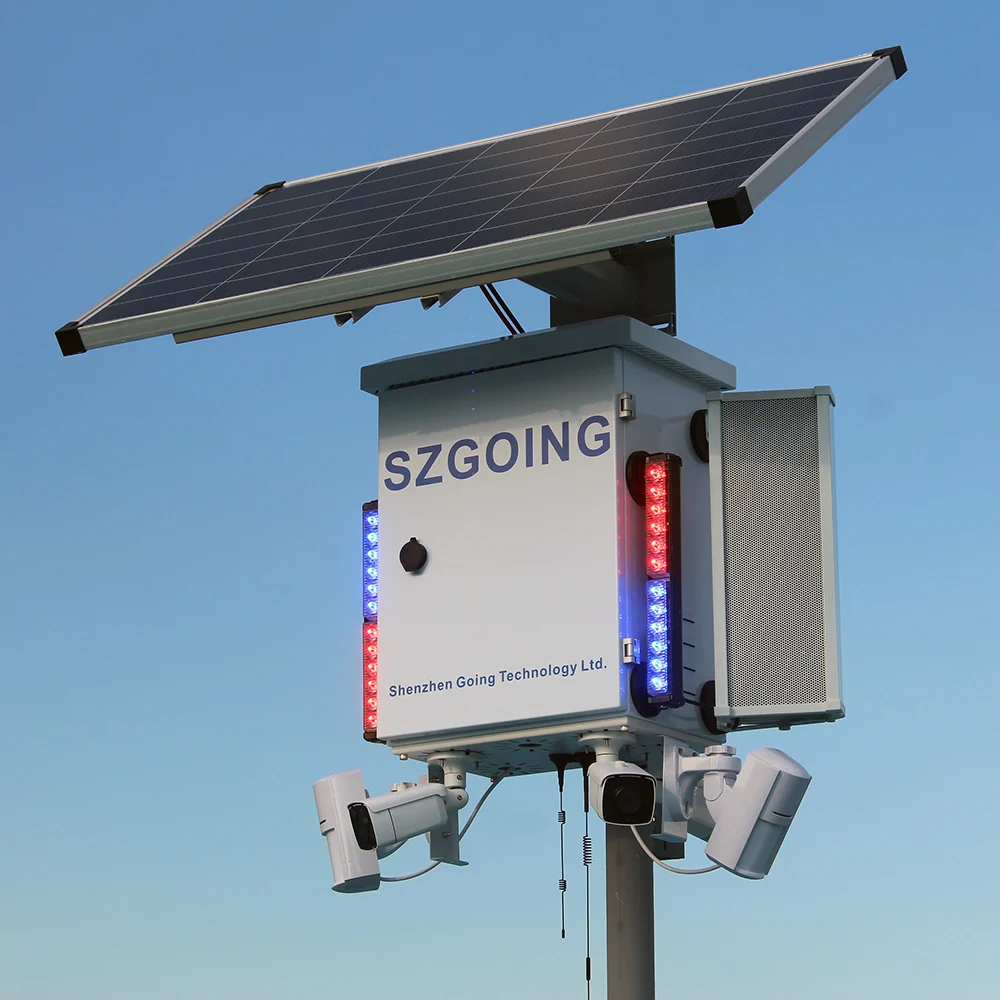
SZGOING BS200-A3 solar site tower: two 100 W panels above a white IP66 box with red-blue light bars, a grey speaker and three white bullet cameras on brackets underneath

Where does this sit next to the two PTZ builds?

It is the coverage build, not the magnification build. Two PTZ heads pan to cover the same circle; three fixed bullets hold it. If the job is knowing the moment anything enters the compound, three lenses beat two motors. If the job is reading the plate on the truck at the gate, nothing replaces 96 mm of glass — that is the PTZ build. Everything else is shared: the same 200 W array, the same Hikvision NVR and Hik-Connect app, the same SIM and DDP terms, and 60 kg instead of 62.

Specifications

Standard configuration

SpecificationDetail
Solution nameBS200-A3SAFL-S (8 MP)
Cameras3 × 8 MP infrared bullet, fixed, Hikvision
Lens2.8 mm fixed, about 105° horizontal
Coverage3 lenses 120° apart — 360° with overlap, no pan or tilt
Night vision25–30 m infrared
CompressionH.265+
Recording1 TB (1,024 GB) in a Hikvision NVR — continuous, timing or motion
Channels4 camera ports; CAM1–CAM3 occupied, CAM4 free
Alarm input2 × outdoor PIR, wired to PIR1 / PIR2 in the box
Alarm output120 dB pre-recorded siren with two-way talk, plus 2 red-blue light bars
Network4G LTE + 2.4 GHz WiFi (802.11 b/g/n), 12 dBi antennas
SIMNano SIM fitted, 100 MB test data, picks the strongest local operator
Band buildEU/Asia/Africa, Americas or Australia — set before dispatch
ProtocolsTCP, UDP, HTTP, FTP, SMTP, DHCP, DNS, ARP, ICMP, POP3, NTP, IPsec, UPnP, RTP, RTCP
Remote accessP2P on the device serial — Hik-Connect app, free 64-channel VMS for Windows
Solar array2 × 100 W mono panel, 18 V / 5.56 A, 21.6 V open circuit, 950 × 530 × 30 mm, 5.5 kg each
Charge control20 A controller inside the equipment box
BatteryNot included — any 12 V pack; 12.8 V 100 Ah LiFePO4 recommended
Equipment box400 × 250 × 500 mm, IP66
MountingPole adapter for 60 mm poles, up to 170 mm on request
Kit weight60 kg as shipped
DeliveryDDP sea or rail plus express, door to door, 3–4 weeks

The table describes the standard build; the order datasheet confirms the final configuration.

Product video

Forty-five seconds on the three-camera build

Panel, box, speaker and all three bullets in sequence, with the burned-in captions the factory shot.

Factory footage; the captions are theirs, the re-encode is ours.

Product description

Coverage, not magnification

The two PTZ builds look at the gate. This one watches the circle — and the arithmetic behind that sentence is worth doing properly before you buy either.

Three times 105° is not quite 360°

A 2.8 mm lens on an 8 MP sensor sees about 105° across. Three of them mounted 120° apart add up to 315° of arc with 45° of overlap at each seam, which is how the factory arrives at the figure of 360°. The overlap is the part that matters in practice: whoever walks across a seam is in two frames at once, so there is no gap to slip through and no argument afterwards about which camera should have seen it.
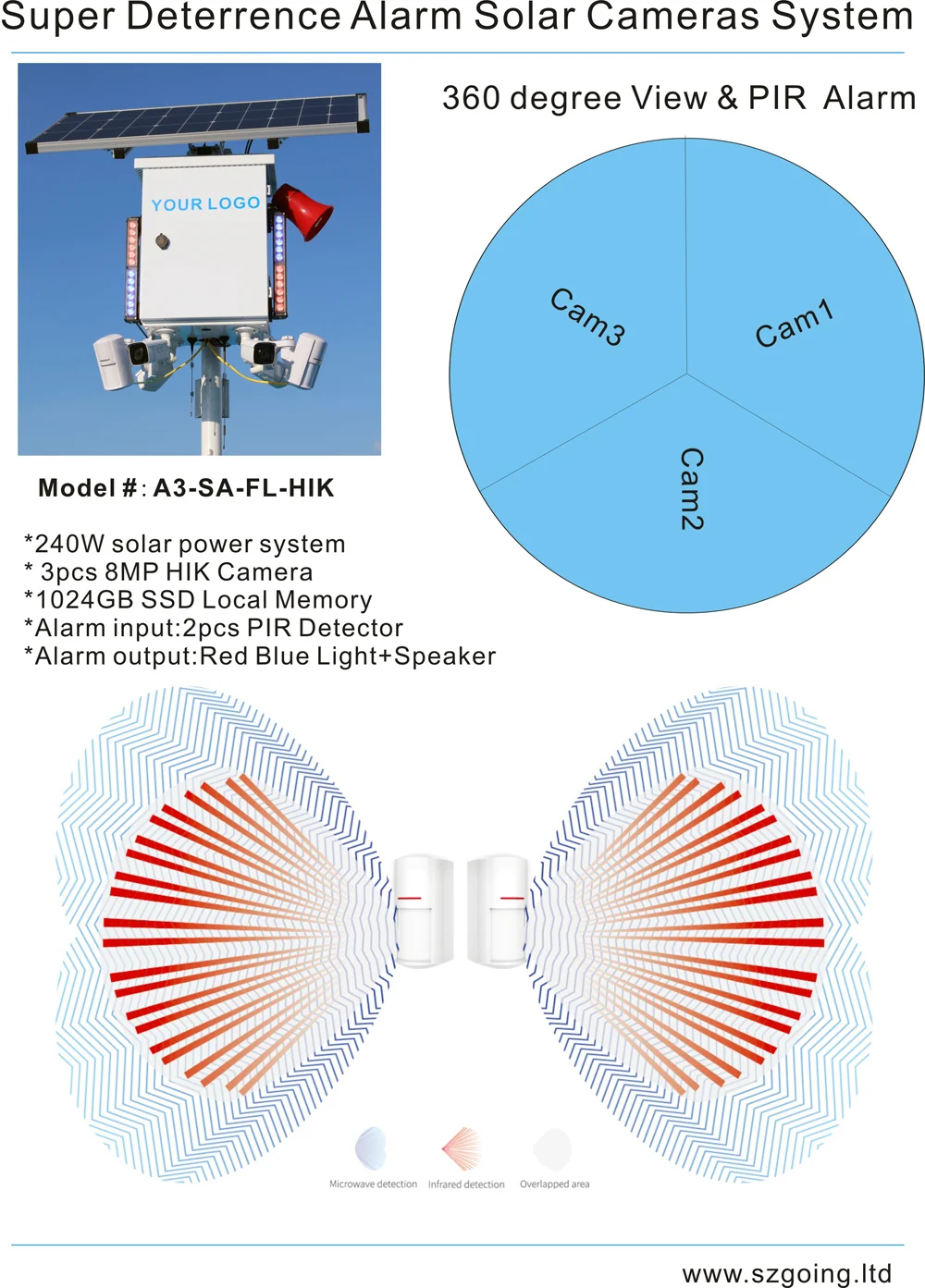
Diagram of the three-camera coverage: a circle divided into Cam1, Cam2 and Cam3 sectors with 360 degree view and PIR alarm marked, next to the tower and a sound coverage pattern
The factory diagram: three 120° sectors, a 120 dB siren and the PIR pair drawn as a lobe pattern. The 240 W in the artwork is the panel figure on their template — the kit ships 2 × 100 W.

Distance is where the arithmetic gets harder, and it is worth saying plainly. At 20 m a 105° frame is 52 m wide, so 3,840 pixels spread across 52 m gives about 74 pixels per metre. On the DORI scale that is observe shading into recognise. A face is identifiable at roughly 6 m, recognisable at about 12 m, and beyond 25 m you are watching shapes cross a line. None of that is a defect — it is what focal length does — and it is the whole reason two PTZ builds sit next to this one in the catalogue.

No motors is a feature, not a saving

A PTZ head contains a pan motor, a tilt motor, a slip ring carrying power and data through the rotating joint, and a belt or gear train behind the dome. Every one of those is a part that can seize after a winter of dust and thermal cycling, and a preset that drifts a degree a month has the gate out of frame by the second year. A fixed bullet is a lens, a sensor and a bracket. The only thing on this tower that can move is the pole.
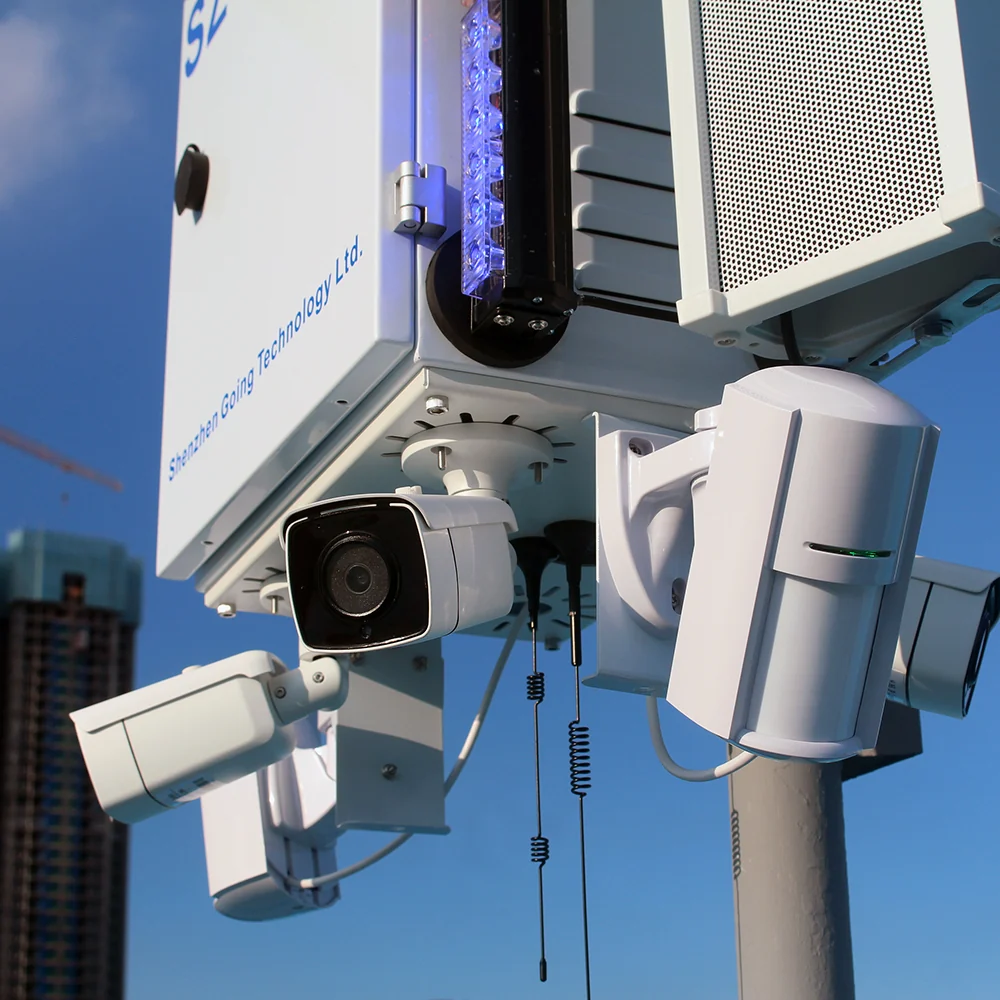
Three white bullet cameras on brackets under the equipment box, beside a lit red-blue alarm bar and the grey speaker grille
Three bullets on one plate, a lit bar and the siren — the whole business end, with nothing in it that rotates.

It changes the install as well. There are no presets to enter, no tour to programme and no home position to declare: the heads were aimed at the factory and the plate clamps to the pole as one piece. If a new container lands in front of one camera, the plate rotates on the pole instead of three cameras being re-aimed from a ladder.

The honest limit: 25 metres

The infrared on these heads is rated 25–30 m, and beyond that the frame goes black rather than noisy — which is easier to work with than a picture that looks like evidence until you try to use it. If the far corner of the site is 80 m away, this kit watches the near half of it and something else has to watch the rest; a 30× head on a PTZ tower is what that something else looks like.
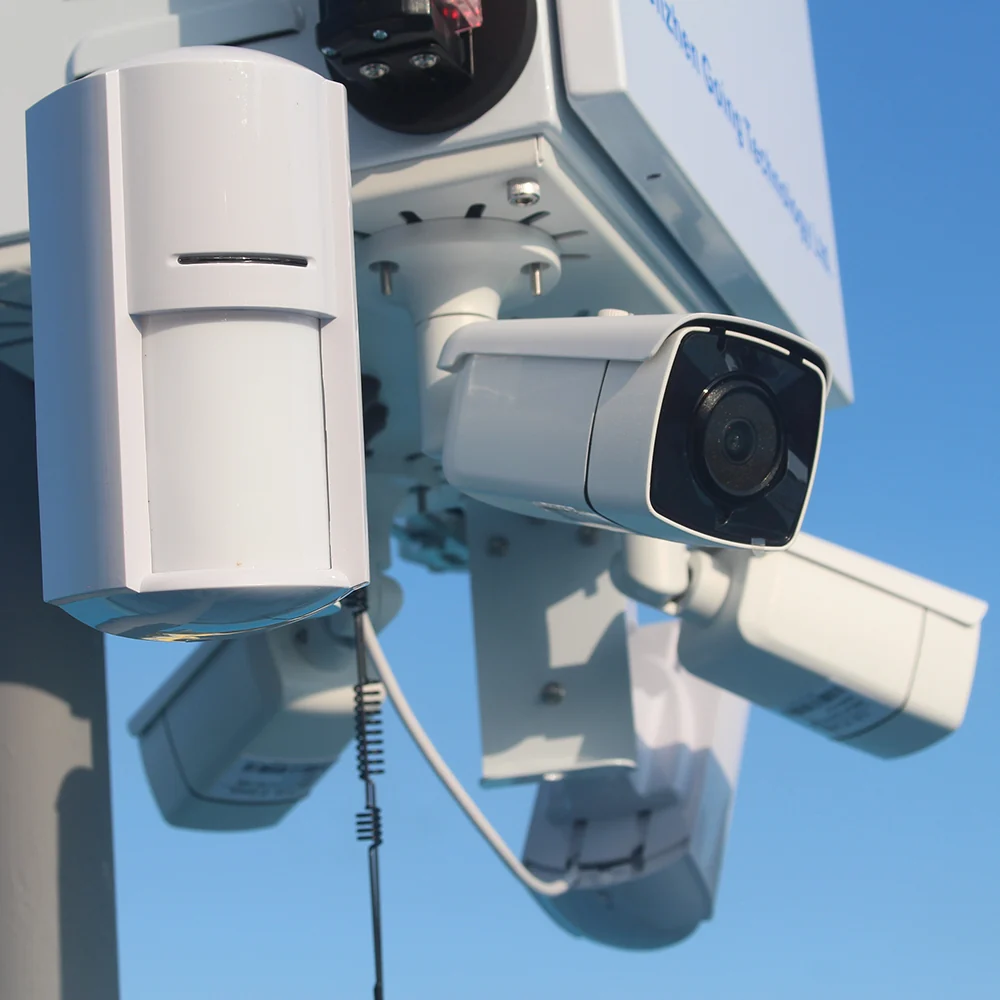
Close view of two of the three white bullet cameras on their brackets, with a white PIR detector beside them
Two of the three heads up close: fixed lens, IR window, bracket. No dome, no gimbal.

The fourth port is empty

The board in the box carries four camera ports, labelled CAM1 to CAM4, plus a separate NVR port for the uplink — and only three are used. That spare is the cheapest form of future-proofing in the whole kit: a fourth Hikvision camera drops onto the same subnet and into the same recorder without a licence, a plan change or a second NVR. The 12 V rail and the cable gland are the only other things a fourth camera needs, and both are far easier to arrange in the workshop than on a ladder in a yard.
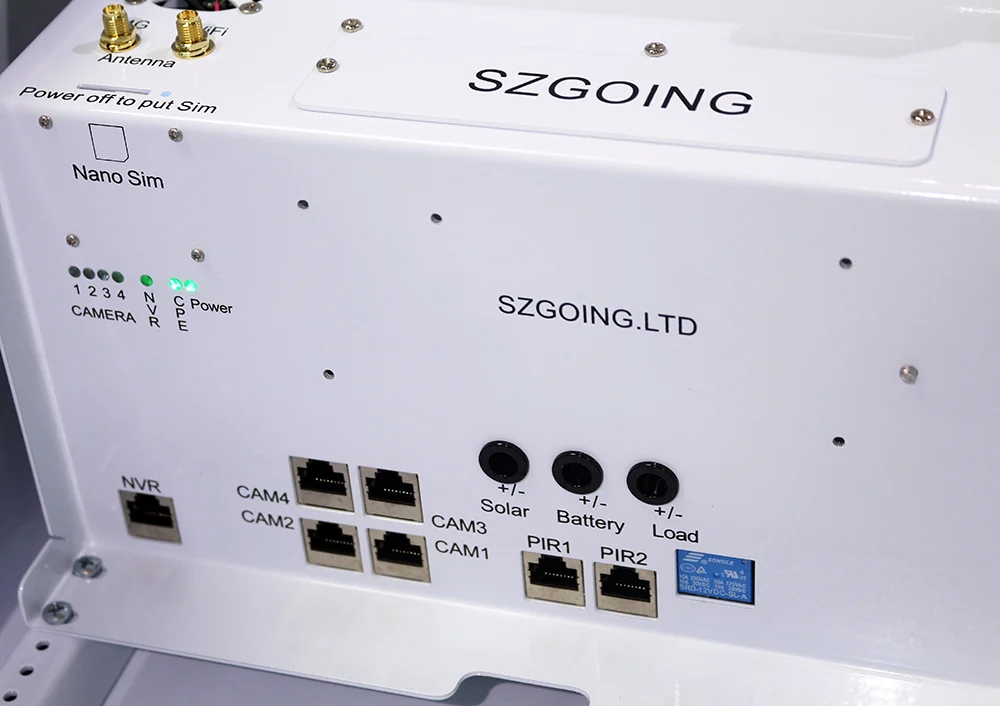
The port panel inside the equipment box: labels for CAM1, CAM2, CAM3, CAM4, the NVR uplink, the solar, battery and load terminals, PIR1 and PIR2, and the Nano SIM slot
The board from above: four camera ports with CAM4 unoccupied, solar / battery / load terminals, PIR inputs and the SIM slot.

The drive fills faster than anyone expects

Three 8 MP streams are not free. At a steady 4 Mbit/s each they write 5.4 GB an hour — about 130 GB a day, which fills a 1 TB drive in eight. Drop them to 2 Mbit/s and it becomes sixteen days; switch to motion-triggered recording and a quiet compound stretches the same drive across months. Set the record mode on the first afternoon rather than discovering it on day nine.

The mobile link has its own arithmetic. Three 4K mainstreams together want 12–24 Mbit/s upstream, which a busy cell will not hold for long, so live view falls back to substream — under 3 Mbit/s for all three, and perfectly usable for spotting that something is happening. When you need to count something, open one mainstream or download the clip. The recording is already on the drive either way; the SIM is for looking, not for storing.
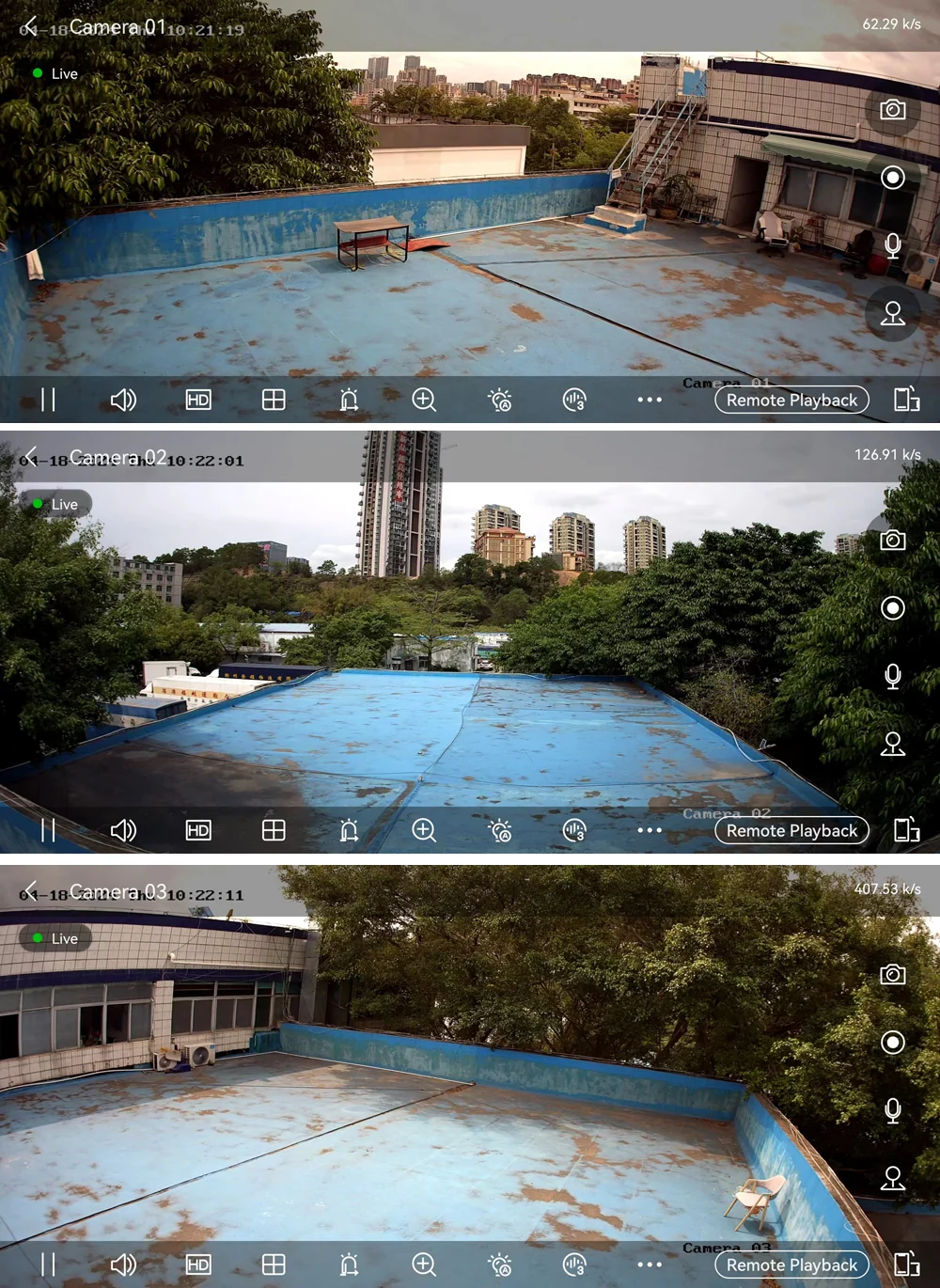
Three live views from cameras 01, 02 and 03 stacked in the Hik-Connect app, each showing the same yard from a different angle
All three in one app: Cam01, Cam02 and Cam03 on the same compound, one after another.

Alarm output, one relay per camera

The two PIR detectors trigger the siren and both light bars together, and the same relay can be closed by hand from the app when the site is empty and somebody wants the siren on demand. The pre-recorded message plays on a trigger; the speaker also carries two-way audio, which is the part that actually changes behaviour — a voice from the box at 02:00 moves people in a way a siren does not.
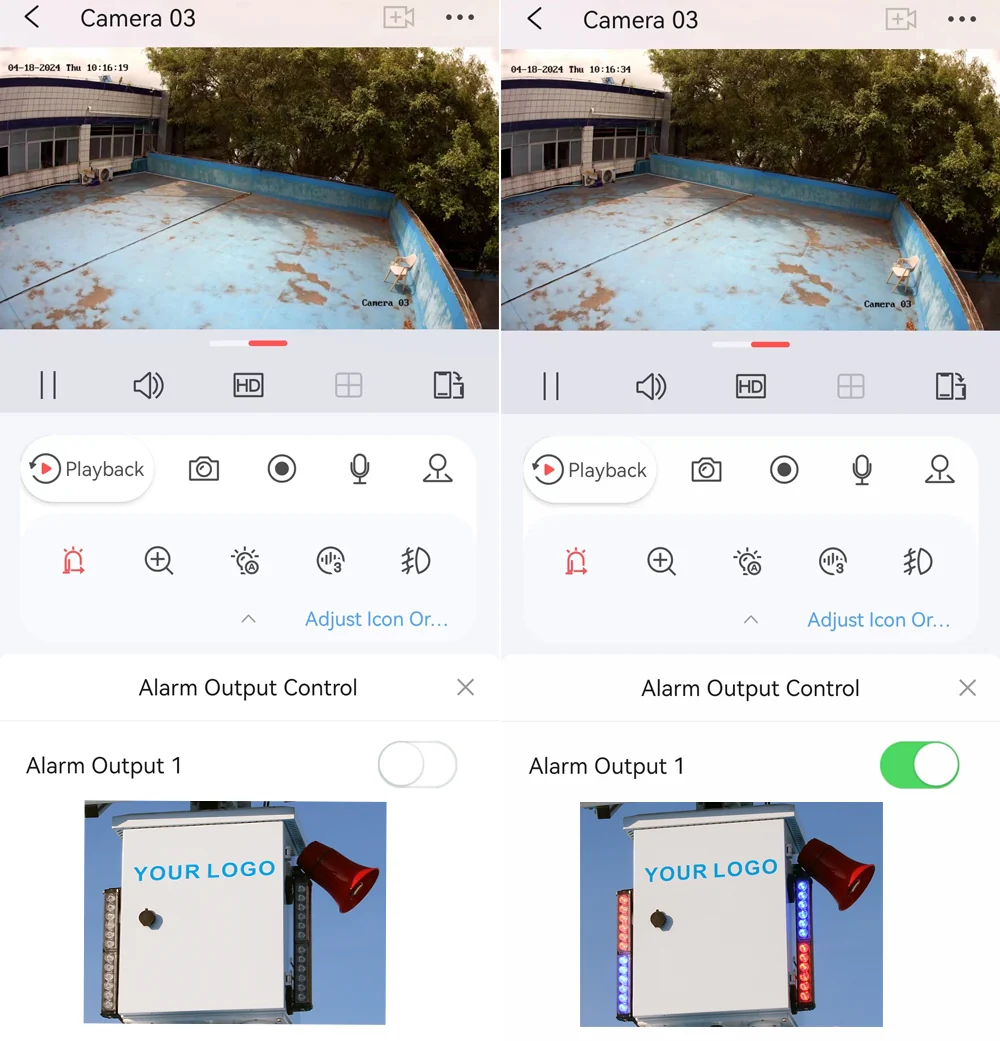
Two phones side by side showing the alarm output control screen for camera 01 and camera 03
Alarm output per camera: two heads, two relays, switched separately.

One crate, same logistics

The kit leaves as a single shipment: three bullets, two 100 W panels on their aluminium brackets, the IP66 box with the router, the 1 TB recorder and the 20 A controller already inside it, two PIR detectors, two light bars, the siren, the antennas, the SIM, the pole adapter and a tool kit. The pole and the battery are deliberately absent — both are cheaper at the other end and the wrong shape to pay freight on. 60 kg as shipped, against 62 for the PTZ builds.
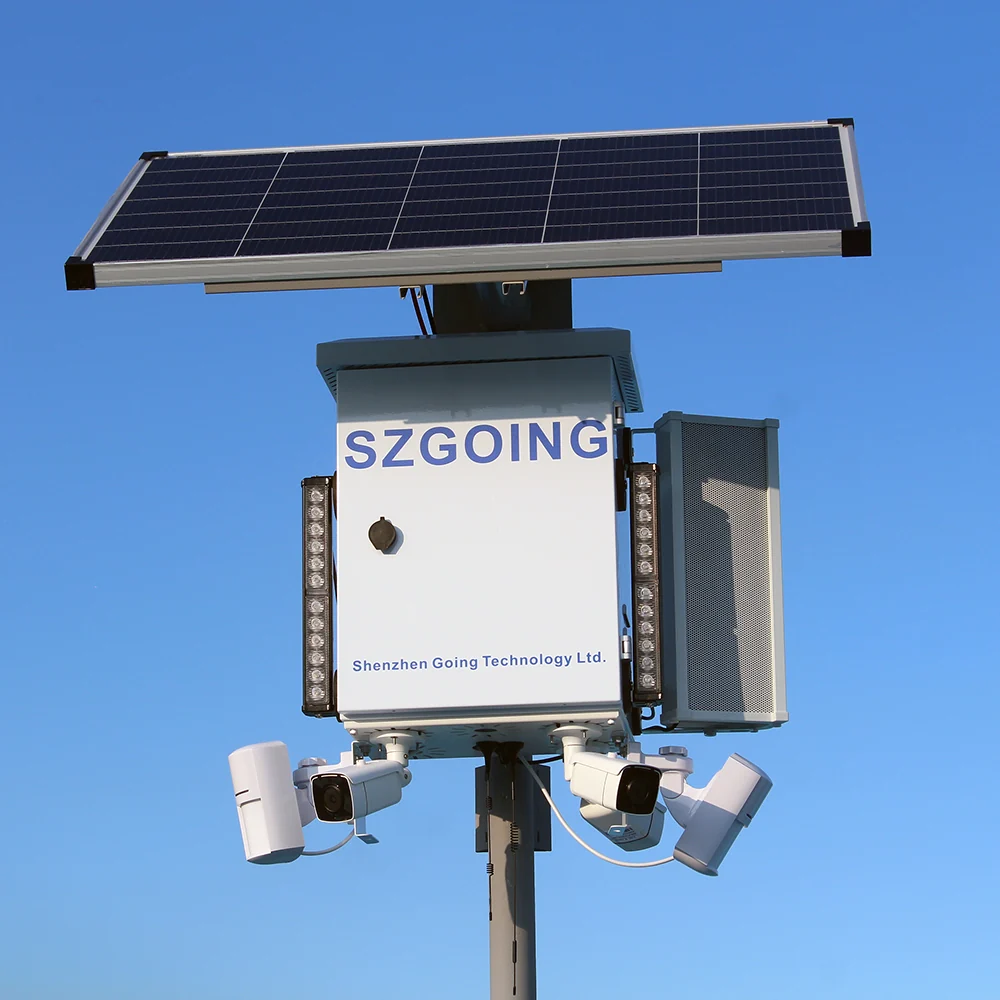
Front view of the A3 tower with both red-blue bars lit and the three bullet cameras below the box
Front on: two bars lit, three heads below, panel above.
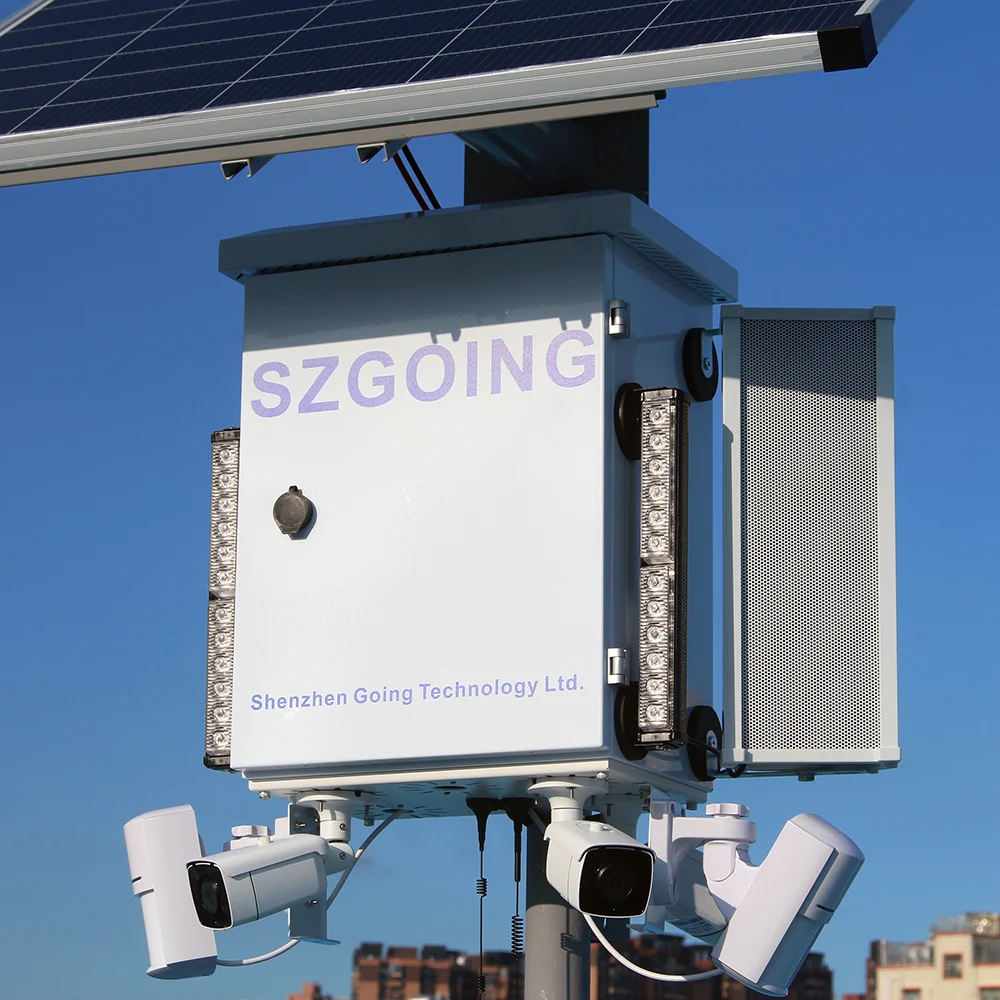
Side of the equipment box showing the grey speaker grille, a lit alarm bar and the panel bracket
The speaker grille on the side face, where the sound leaves the box.

Which of the three builds

Same platform, same box, same app, three different sets of glass. The right choice is almost always decided by one question: does the site need to know that something happened, or does it need to know who did it?

BuildCamerasLensInfraredWeight
BS200 (-FL)2 × PTZ, 8 MP3.2–96 mm, 30× optical100 m62 kg
BS200-SA2 × PTZ, 8 MP3.2–96 mm, 30× optical100 m62 kg
BS200-A3 (this kit)3 × bullet, 8 MP2.8 mm fixed25–30 m60 kg

Coverage wants the A3: it holds the whole circle, it has a spare channel and it has nothing in the head that wears out. Identification wants either PTZ build: 96 mm of glass reads a plate at a distance no wide lens can, and the horn siren on the -SA throws the alarm out from the pole rather than down at its base. Sites that need both usually take a PTZ tower at the gate and a wide build inside the fence.
The A3 tower three-quarter with the panel edge lit, both alarm bars on and the three cameras under the box
Panel, box, siren, three heads — one pole, one crate, 60 kg.

Three things to settle before the crate is sealed

Coverage is geometry, not a feature

Three 2.8 mm lenses 120° apart give 315° of arc plus 45° of overlap at each seam, which is how the factory arrives at 360°. The overlap is the useful part: whoever crosses a seam is in two frames at once, so nothing slips between cameras. Two moving heads can cover the same circle, but only one of them is looking at any given metre at any given second.

Nothing in the head that moves

A PTZ has a pan motor, a tilt motor, a slip ring through the rotating joint and a belt behind the dome — four failure modes a fixed bullet does not have. There are also no presets to drift, no tours to reprogramme and no home position to lose, which is why this build tends to survive year three in better shape than a camera that was never serviced.

One SIM, three 8 MP streams

Recording is local, so the drive does not care about the link. Live view does. Three 4K mainstreams need 12–24 Mbit/s upstream, more than most 4G cells give for long; the substreams need under 3 Mbit/s for all three. Watch on substream, pull a mainstream when you need detail, and download the clip rather than streaming it.

Questions

Questions

Will three 8 MP cameras work over one 4G SIM?

Yes, with one caveat that decides the workflow. All three record at full resolution to the drive inside the box, and that never touches the mobile network. Live view does: three 4K mainstreams together want 12–24 Mbit/s upstream, which a busy cell will not sustain, so the app falls back and the picture stutters. Watch the substream for all three, which is under 3 Mbit/s in total, then open one mainstream — or pull the recording off the drive — when you need to count something. That is how the kit is meant to be used, and it is why the recorder is in the box rather than in a cloud plan.

Can I add a fourth camera later?

The board in the box has four camera ports and three are occupied — CAM4 is wired and empty. A fourth Hikvision IP camera on the same subnet is a network drop and a 12 V feed away, and the NVR will pick it up without a licence or a plan change. It is worth doing at order time if you already know the blind corner: the port is free, but the 12 V rail and the cable gland are easier to arrange in Shenzhen than on a ladder.

How far can it actually see at night?

The infrared reaches 25–30 m, and that is the honest limit — beyond it the picture goes black rather than noisy. By day the limit is pixel density: a 105° frame at 20 m is 52 m wide, so 3,840 pixels give about 74 per metre. A face is identifiable at roughly 6 m, recognisable at 12 m, and a person is observable to 20 m; past 25 m you are watching shapes cross a line. That is the right instrument for a compound or a fence line, and the wrong one for reading a plate at a gate 80 m away.

Do the three cameras need aiming on site?

No. The three bullets are fixed to the mounting plate at 120° at the factory, and the plate clamps to the pole as one assembly, so the only decision on site is which way the seam points. If the layout changes — a new container blocks one view — the whole plate rotates on the pole rather than three cameras being re-aimed and re-focused. Fixed lenses are focused at the factory too, so there is no focus ring to knock.

What is different from the two BS200 PTZ builds?

Cameras and reach. The PTZ builds carry two 8 MP heads with 30× optical zoom at 3.2–96 mm and 100 m of infrared; this one carries three fixed 8 MP bullets at 2.8 mm with 25–30 m. Everything below the plate is the same: 200 W of panel on the aluminium bracket, the 20 A controller, the 1 TB Hikvision NVR, the router, the PIR pair, the siren and the SIM. The kit is 60 kg rather than 62. If you are choosing between them, the category page sets the three side by side.

Quote a BS200-A3 to your address

Send the delivery country, how much of the compound has to be covered, and the hours of recording you want. You get the band build, the battery size and a landed price in one reply.