H10: a trail camera that carries its own solar panel up the pole
The H10 skips the second box. Most solar trail cameras send the panel separately: a second fixing point, a second cable, two trips up the ladder. Here the 6 W panel is bolted to the bracket above the housing, so camera, panel and antenna go up as one piece. Underneath sits a 3.6 mm 90° lens, 4 MP stills, 3 MP video, infrared to 30 m and three 18650 cells — and the clip comes back over 4G while the animal is still in the frame.
- 6 W solar panel bolted to the bracket above the housing — one fixing point, one lift
- 4 MP stills and 3 MP video through a 3.6 mm lens covering 90°
- Infrared to 30 m with automatic day/night switching
- PIR event recording, with motion alerts pushed to the UCON app
- Three 18650 cells, camouflage IP65 housing, MOQ 1 piece
- 4G LTE with your own data SIM — Asia, EU/AU/NZ or US/Americas band builds
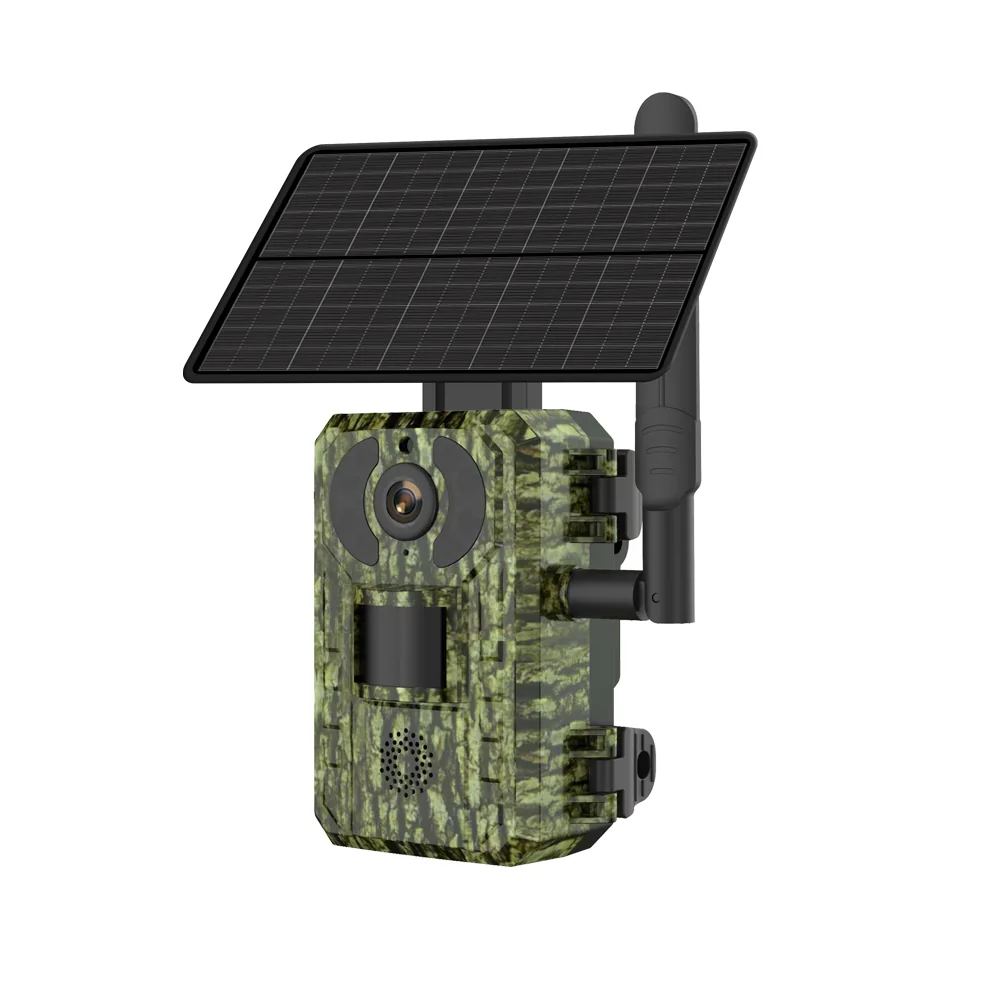
What does putting the panel on the bracket actually change?
It removes the second fixing point. A panel that ships loose has to be strapped to its own post, aimed at the sky and cabled back to the camera — three jobs instead of one, and the cable is the part that fails first. Bolted above the housing it rides at the same angle as the camera, the lead is short and the whole kit takes one bracket. The trade is honest: 6 W is a maintenance charge for three 18650 cells, not a camera that runs on daylight alone through a dark northern winter.
Standard configuration
| Specification | Detail |
|---|---|
| Model | H10 — 4G solar trail camera, 6 W panel on the mounting bracket |
| Imaging | 4 MP stills, 3 MP video, CMOS sensor |
| Lens | 3.6 mm, 90° field of view |
| Night vision | Infrared to 30 m, automatic day/night switching |
| Detection | PIR motion sensor with the alarm pushed to the app |
| Recording | Event clips and stills written to the card |
| Storage | microSD card |
| Network | 4G LTE with SIM slot — Asia, EU/AU/NZ or US/Americas band builds |
| App | UCON — settings, clips and motion alerts |
| Power | 6 W solar panel on the bracket, three 18650 cells |
| Housing | Camouflage print, IP65 |
| Mounting | Panel bracket on the housing top; camera and bracket mount as one piece |
| Packaging | 20 × 17 × 12 cm, 1.5 kg per set |
| Customisation | Logo and retail packaging from 500 pieces |
The table describes the standard build; the order datasheet confirms the final configuration.
Where the specification stops and the field starts
One lift, not three
Panel, bracket and camera leave the carton as one assembly. On a pole at the edge of a field that is the difference between one climb with a strap and a morning spent aiming a panel, running a cable and hoping the connector survives the weather.
30 m of infrared, and a clip that starts on the first step
The PIR wakes the camera on movement, so the recording begins when the subject does. At night the infrared reaches 30 m, which covers the trail in front of the lens rather than the field behind it.
Nobody drives out to collect a card
On a farm, a forestry block or a lease two hours from home, the card is the expensive part. The clip lands in the app over the mobile network; the card stays in the camera as the backup, not as the delivery mechanism.
Questions about the 4G solar trail camera
Do I need a subscription?
No proprietary plan. The camera takes a standard data SIM and the clip reaches the app over your operator's data allowance — which matters on a lease where the only signal is one bar of 4G on a ridge.
How long does it run without sun?
Three 18650 cells with 6 W trickling in during daylight, so in normal event use it lives on solar. Endurance then depends on how often it triggers and how much infrared it burns at night. Tell us the site and the season and we answer with a figure for the worst month rather than a yearly average.
Is it 4 MP, 3 MP or 4K?
4 MP for stills and 3 MP for video — that is what the hardware and the listing attributes say, and it is what we publish. A 4K trail camera is a different model in the range; ask for it explicitly if that is the requirement.
Is a 90° lens wide enough?
90° is a deliberate choice for identification. At the five to fifteen metres a camera normally hangs from a trail it puts a recognisable animal in the frame, instead of a wide empty field with a small shape in the middle. If you need to watch a whole clearing rather than a crossing point, the A8 is the 120° model in the range.
Can it watch a building site instead of a game trail?
It can, and customers do, but be clear about the trade: a trail camera records events, not whole days. If a compound needs continuous coverage, the AOV solar camera records 24 hours at low power and is the better tool for that job.
Can it carry our brand?
Yes. Logo and retail packaging are customisable from 500 pieces; before that we ship single units at sample price so you can check the print and the trigger before committing.
Hang one this week
Single units ship from stock. Tell us the country and we set the 4G band and the app region before the parcel leaves Shenzhen.