One pole, two lenses: 100x zoom for detail and a wide PTZ head for the whole site
A pole camera usually makes you choose — a wide view of everything, or a long lens that can read a face at the fence line. This rig carries both: a zoom head above, a pan-tilt dome below, 12 W of solar on the crossbar and a 9,600 mAh pack between them. No mains cable, no trenching, no subscription.
- Two independent heads — long-range zoom above, wide PTZ dome below
- Both feeds on one screen: the app shows the wide view beside the 100x pane
- 6 MP CMOS imaging; the zoom slider runs 1.0x to 100.0x
- 2 × 12 W solar panels on the crossbar, 9,600 mAh battery
- 4G LTE in five band versions, or 2.4 GHz Wi-Fi
- PIR with AI human-shape filtering; full-colour and IR night modes
- IP66 ABS and aluminium alloy housing in white or dark grey, 1 piece MOQ
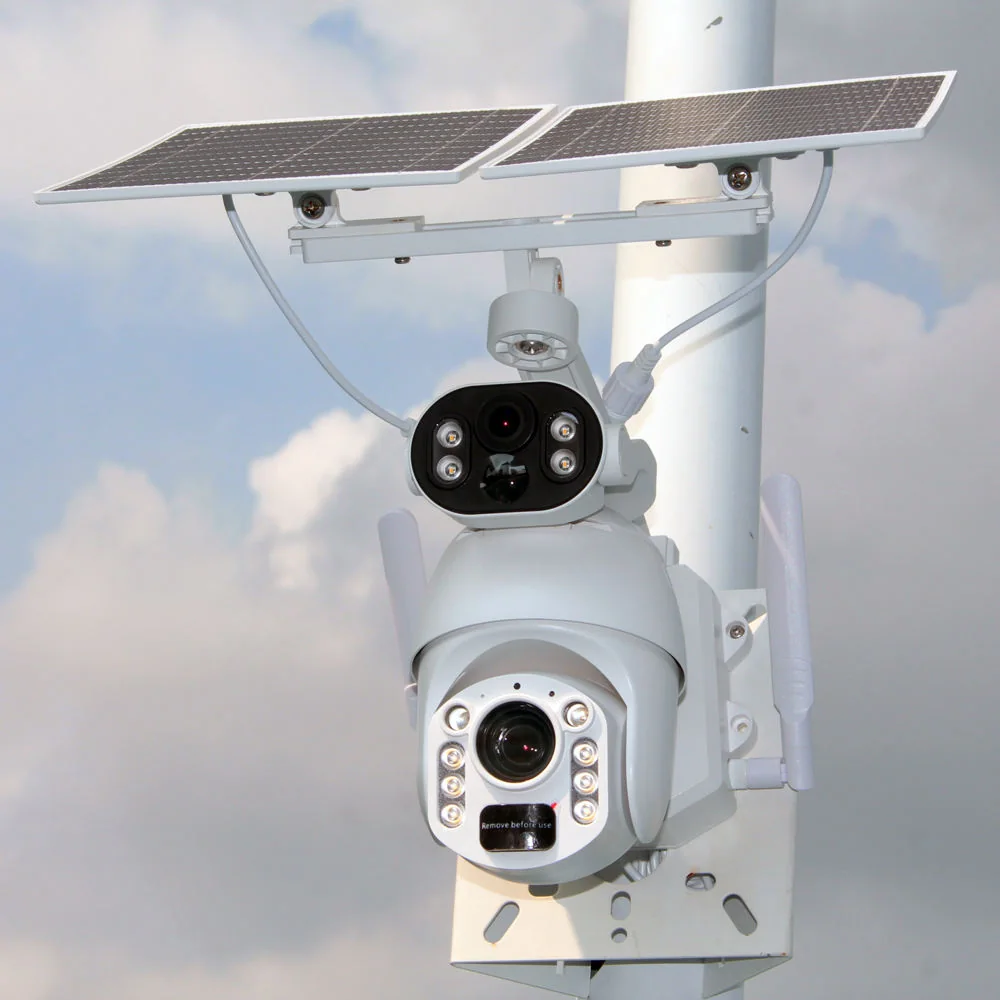
Two housing colours, one build: white (100X-DH-W) and dark grey (100X-DH-B). Same heads, same 12 W array, same 9,600 mAh pack — name the colour on the order, and mixed pallets are fine at one piece each.
What does “100x zoom, 2 in 1” actually mean on this camera?
It means two cameras in one housing, not one lens that reaches 100x. The upper head carries the long lens and the lower one is a wide pan-tilt dome with its own sensor. Because they are separate imagers, the app can show the wide scene and a magnified crop of it at the same time, side by side — you spot movement in one pane and identify what caused it in the other.
Headline numbers
- Heads2 (zoom + wide)
- Zoom1.0x–100.0x
- Imaging6 MP CMOS
- Solar2 × 12 W
- Battery9,600 mAh
- RatingIP66
You stop choosing between overview and detail
On a single-lens PTZ you zoom in and lose the rest of the yard; zoom out and the gate is twelve pixels wide. Two sensors on the same pole removes that trade — the wide pane never leaves, so the zoomed pane is an addition rather than a replacement.
One bracket carries the power too
The panels sit on a crossbar above the heads and feed them through a short cable, so there is no separate solar cabinet to mount, and nothing to dig a trench for. Pole, panels and both cameras go up in one lift — which is the difference between a two-man morning and a two-day job on a remote site.
The long lens is for identity, the dome is for context
They sit inches apart on the same bracket and look at the same site, but they are not interchangeable. Pick which one you mount the rig for — the other becomes the safety net.
| Upper zoom head | Lower PTZ dome | |
|---|---|---|
| Field of view | Narrow — the far end of the site | Wide — the approach, the yard, the gate area |
| What it answers | Who is that, and what are they carrying | Is anything happening anywhere |
| Zoom | 1.0x–100.0x from the app slider | Fixed wide lens |
| Movement | Set on the choke point when you install it | Driven from the app — direction pad, speed, PTZ reset |
| At night | IR and white light | IR and white light, with full-colour mode |
The practical installation is to point the long head at the one place a vehicle or a person has to pass — a gate, a cattle grid, the top of a track — and leave the dome to sweep everything else. Aiming both at the same spot wastes the second head.
Both heads, the panel crossbar and the app
Forty-five seconds: the rig on a pole, the two heads working, and the split-screen view where the wide pane and the 100x pane run together.
Clip: 100X Zoom dual-head solar camera. Filmed on our own line — the same build that ships on an order.
Standard build sheet
What leaves the line by default. SIM band version, card size and branding are set on the order.
| Specification | Detail |
|---|---|
| Model | 100X Zoom dual-head solar camera (2 in 1) |
| Imaging | 6 MP total — two 3 MP CMOS sensors; a long-range zoom head above a wide PTZ dome |
| Zoom | 1.0x–100.0x on the app slider (hybrid, not purely optical) |
| Pan / tilt | Motorised pan-tilt on the lower dome, with speed control and PTZ reset in the app |
| Night vision | Infrared plus white-light LEDs; full-colour and IR modes switchable |
| Detection | PIR sensor with AI human-shape filtering |
| Audio | Two-way talk, built-in microphone, alarm I/O |
| Network | 4G LTE in five band versions — Asia, Africa, EU/AU/NZ, Japan, America — or 2.4 GHz Wi-Fi |
| Storage | TF / SD card and cloud |
| Power | 2 × 12 W solar panels on the mounting crossbar, 9,600 mAh battery |
| Housing | ABS + aluminium alloy, IP66 weatherproof |
| Finish | White (100X-DH-W) or dark grey (100X-DH-B); OEM colour on volume |
| App | Free app — live view, split screen wide + zoom, playback, PTZ control |
| Mounting | Pole bracket with a panel crossbar; a wall needs a mast |
| Ordering | 1 piece MOQ; both colours are one build; OEM branding on housing and carton |
The factory sheet for this body does not state pan and tilt angles, per-lens focal lengths or IR range, so they are not printed above. We send the datasheet with those figures when we quote — ask for it even if you are only comparing. The 100x figure is the supplier’s rating for the long head and covers hybrid, not purely optical, magnification. Resolution is often quoted per sensor: each head is 3 MP, and the pair is the 6 MP above — some listings for this body say “3 MP” for exactly that reason.
What arrives with it
One unit per carton, with the bracket and panel crossbar already assembled:
- Camera assembly — zoom head and PTZ dome on one mounting plate
- Two 12 W solar panels with the crossbar and their cable harness
- Pole bracket and clamp, screws and plugs
- 4G antennas (screw-on, fit before powering up)
- 9,600 mAh battery pack, part-charged for testing
- USB charging cable for pre-deployment charging
- Quick-start card with the app pairing code
- TF card optional — specify the size on the order
OEM orders ship with your logo on the housing and your artwork on the carton and quick-start card.
Mounting it properly
Charge it indoors first
A unit that has sat in a warehouse arrives with a near-flat pack, and 12 W of panel will not rescue that on day one. Top it up before the climb.
Face the panels, then set the heads
Point the array at the equator and check it sees midday sky — both panels, not just one. Only then set the camera. Satisfying both in one bracket position is the usual reason a site goes dark in its first cloudy week.
Long head on the choke point
Put the zoom head on the gate, the track junction or the compound entrance, working from the distance you actually need. Then let the dome cover everything else. Do not aim both at the same wall.
Antennas, then SIM, then app
Fit both antennas before powering the module, insert the data SIM, then pair in the app. Confirm the signal and solar icons on the status bar before you leave — that screen is the only warning you get before the site goes quiet.
Ask for a sample clip at your working distance
Send the distance from the pole to what you need to read, the pole height and the destination country. We reply with the matching SIM band version, a real clip from that range and an honest answer on whether 12 W of panel is enough for your latitude.
100x zoom solar camera FAQ
Is the 100x zoom optical?
No, and any listing that implies otherwise is overselling. The factory rates this head at 100x; on the phone the slider runs 1.0x to 100.0x, and only the first part of that range is glass. What the long lens buys you is the ability to fill the frame with a gate, a track or a compound entrance from the far side of the site — which is what actually matters when you are trying to identify a vehicle rather than just detect it. At the top of the range, pole vibration and heat shimmer cost you more sharpness than the glass does, so ask for a sample clip at your working distance before you commit to a quantity.
Two heads — do I see both pictures at once?
Yes. Each head is its own sensor and its own stream, so the app opens a split screen: the wide dome on one side, the zoom head on the other, both live. That is the whole point of the layout. You watch the wide view for movement and read the detail on the second pane without touching the controls, instead of losing the overview every time you zoom in.
Will 12 W of solar keep it alive through winter?
12 W into a 9,600 mAh pack covers a normal duty cycle — live view when you look, recording to the card, IR at night — across southern Europe, Latin America, Africa and most of Southeast Asia. North of about 45° latitude, or on a pole that is shaded for part of the day, it is not enough, and we will say so before you order rather than after. For those sites we quote the same camera on the 100–200 W panel kit, or the 4K PTZ site kit.
4G or Wi-Fi — and which SIM version?
It is a factory option, not an accessory you add later. There are five 4G band versions — Asia, Africa, EU/AU/NZ, Japan and America — plus a Wi-Fi-only build for sites that already have a link. Tell us the destination country and the carrier if you know it; we ship the matching module.
What keeps it from crying wolf?
The PIR triggers on heat, and the AI filter on top of it is set to human and vehicle shapes, so moving foliage, livestock and headlights do not push an alert to your phone every hour. On a farm or a construction site that difference decides whether anyone still looks at the notifications by week three.
Can it record with no SIM in it?
Yes. Recording to the card and the alarm siren run locally, so a site with no coverage still has a working recorder and a deterrent. The SIM is what gives you remote live view, playback and push alerts. Cloud storage is available as an option if you need footage to survive the camera being taken off the pole.
Do you publish pan-tilt angles and IR distance?
Not on this page, because the factory sheet for this body does not state them and we are not going to print a number we cannot stand behind. We send the datasheet with the pan and tilt angles, the per-lens focal lengths and the IR range when we quote — ask for it and you will have it the same day.