GT70480M · Construction site · 4G/5G

A tower you tow, not a pole you climb

Every other build in this category bolts to a 60 mm pole that somebody else drives into the ground. This one is a trailer: single axle, four legs, a hand crank that takes the mast to six metres, 890 W of panel over 7,200 Wh of battery, and four cameras recorded to a 2 TB SSD inside the box. It is the only system here that moves when the fence line moves.

  • 1 × 8 MP 30× PTZ at 3.2–96 mm, plus 3 × 8 MP bullets at 2.8 mm — four channels in one box
  • 890 W on two 445 W mono panels, charging 7,200 Wh of gel in four 12 V 150 Ah blocks
  • Hand-cranked mast to 6 m: 40 kg payload, level-8 wind rating, four manual support legs
  • 2 TB SSD recorder in the box — about eleven days for all four channels at 4 Mbit/s
  • 4G or 5G with a 12 dBi antenna, Hik-Connect app, free VMS for PC
  • Two red-blue beacons on the alarm relay, −35 to 60 °C, IP66 body
SZGOING GT70480M solar CCTV trailer: a white single-axle trailer with two tilted solar panels, a telescopic mast raised to six metres and a camera head at the top

Why a trailer instead of a pole?

Two things on a site change, and a pole cannot answer either. The fence line moves as the build goes up, and the array a pole can carry is limited by what two people can lift. A trailer answers both: it goes where the work is, and 890 W of panel on a trailer deck does not have to be carried anywhere. What you pay for that is a tow vehicle, a level patch of ground, and a mast that has to come down before you move it.

Specifications

Standard configuration

SpecificationDetail
Solution nameGT70480M
Cameras1 × PTZ + 3 × bullet, 8 MP each, Sony 415 — four channels
ZoomPTZ 30× optical, 3.2–96 mm; bullets fixed 2.8 mm wide
Pan / tilt0–360° endless pan, 0–90° tilt on the PTZ
Night visionPTZ 100 m infrared and full colour; bullets 25 m infrared
CompressionH.265+
Storage2 TB SSD in the NVR, inside the equipment box
Recording time≈11 days for four channels at 4 Mbit/s each; ≈23 days at 2 Mbit/s
Network4G LTE (EU/Asia/Africa, Americas, Australia band plans) or 5G; 2.4 GHz WiFi
Remote accessP2P on the device serial — Hik-Connect app, free VMS for PC
Alarm2 × red-blue beacon on the alarm relay, triggerable from the app
Solar array2 × 445 W mono, 890 W total, cell efficiency ≥21.5%
Charge controlMPPT 24 V 40 A, tracking efficiency ≥99%
Battery4 × 12 V 150 Ah gel, 7,200 Wh, ≥80% usable — included
Power budget≈0.6 kWh a day for four cameras plus router; ≈1.8 kWh harvested at two peak-sun hours
MastHand crank, 6 m, 40 kg payload, level-8 wind rating
TrailerSingle axle, 15" tyres, four manual legs, 50 mm ball or 70 mm ring tow hook
Operating range−35 to 60 °C; 6.5 h to full charge from flat at full sun
DeliveryDDP sea or rail plus express, door to door, 3–4 weeks
ConfigurationAlso available as 4 × 8 MP 30× PTZ on the same trailer

The table describes the standard build; the order datasheet confirms the final configuration.

Product video

Thirty seconds of what the four channels see

A gate, a footpath, a fence line and the road behind it — the picture this system actually delivers, including the moment the software draws a box around a person and the zoom goes to 17×. Factory footage, watermark and timestamp left in.

Factory footage; the trim and re-encode are ours.

Product description

The build for a site that moves

Why we put a 890 W array on a trailer, and what that costs you.

A pole is a decision you make once

Every other tower on this page assumes the pole stays where it is put. That is a good assumption on a finished site and a bad one on a build: the compound moves from the front corner to the rear as the structure goes up, the gate moves with it, and the fence line follows the hoarding. Moving a pole-mounted system means a new pole, a new concrete collar, a lift and an afternoon — which is why most sites leave the camera where it was and stop trusting it. A trailer with four legs and a jockey wheel moves in the time it takes to wind the mast down.

  • 890 W on two 445 W mono panels, 7,200 Wh of gel, included in the price
  • 6 m hand-cranked mast, 40 kg payload, level-8 wind, four manual legs
  • Four channels: one 30× head and three 2.8 mm bullets
  • 2 TB SSD recorder, ≈11 days for all four channels, no cloud fee
  • Transport position is mast down and panels flat — under a metre and a half tall

The cost is honest and it is not small. You need something to tow it with, a level patch to drop the legs on, and a decision about who owns the trailer when the job ends — on a site with three subcontractors, that last one matters more than the specification.

What 890 W actually buys

The other builds here run 100 W or 200 W because they have to be lifted onto a pole by two people. A trailer does not, so the array is sized by the load instead of by the lift. Four 8 MP cameras, an SSD recorder and a 4G router sit near 0.6 kWh a day. Two 445 W panels return about 1.8 kWh on a two-peak-sun day and still about 0.9 kWh on a bad January one. That is a system which is net positive in the month that breaks every other solar camera on the site — and it is why the battery is gel rather than lithium: at this size, gel costs about half as much per usable watt-hour, and the trailer has the payload to carry it.
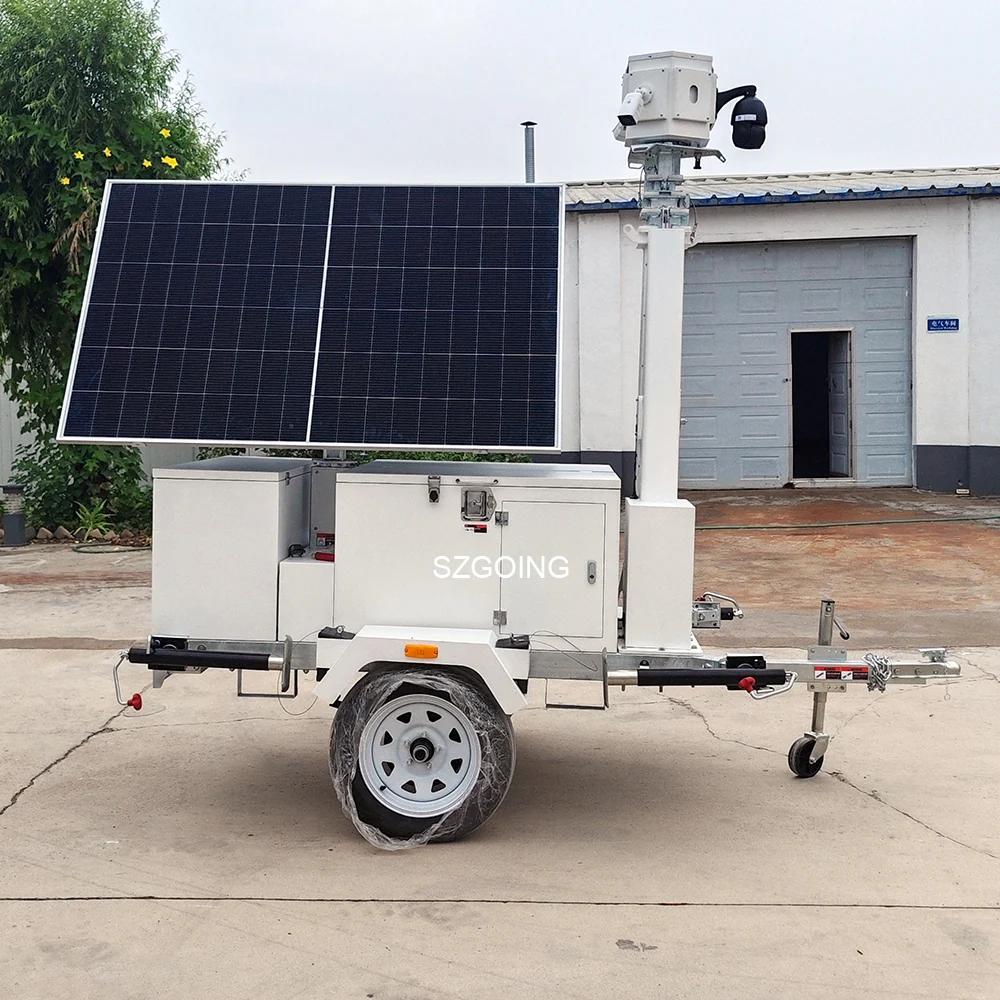
Side view of the GT70480M solar trailer with the mast raised and both solar panels upright, the tow bar resting on its jockey wheel
Side on: mast up, panels up, tow bar down. The legs take the load before the crank goes up.
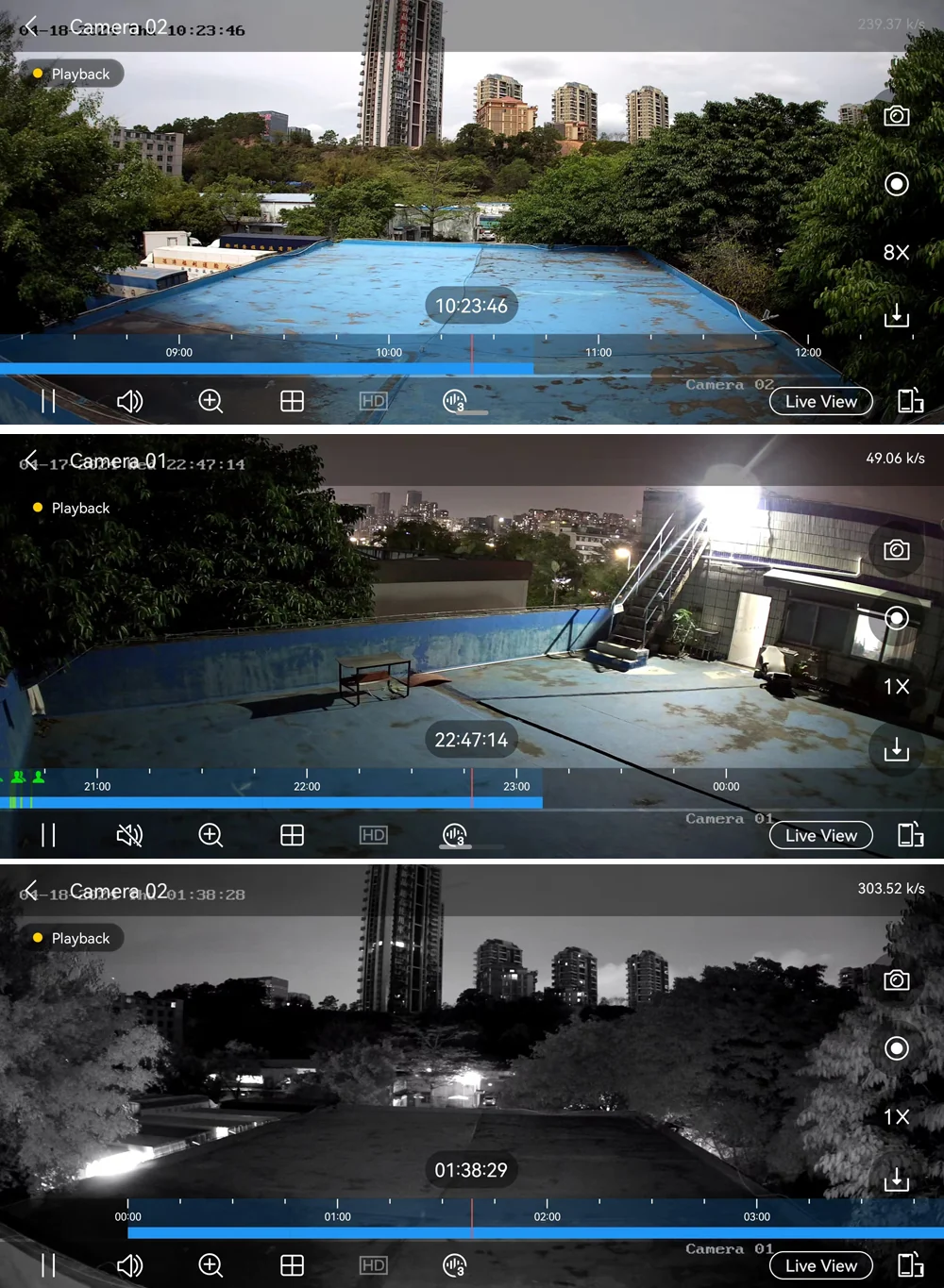
Three Hik-Connect playback screens stacked: a rooftop in daylight, the same yard lit at night in colour, and the same view in infrared after midnight
Playback, one day: daylight, colour at 22:47, infrared at 01:38.

Four cameras doing two jobs

The mixed configuration is the one we quote most, because the two kinds of camera answer different questions. The 30× head pans endlessly and reads a plate at a hundred metres — that is the road, the gate approach and the far corner. The three 2.8 mm bullets are wide and fixed: they hold the compound itself, the hoarding and the material stacks, and they never miss the first second of an incident because nothing in them moves. If every direction needs zoom, take the four-head version; the recorder has the channels either way.

Who should not buy this

Anyone whose camera is going to stay where it is put. A pole-mounted kit on the same site costs a fraction of this, weighs 62 kg and does the same job on 200 W — the quad PTZ build gives you four 30× heads for a third of the money. Buy the trailer when the site moves, when the ground will not take a pole, or when the array has to survive a winter nobody is watching. Buy it for the tow, not for the spec sheet.

Three things the trailer changes

890 W is not a bigger 200 W — it changes the season

Two 445 W panels return about 1.8 kWh on a two-peak-sun day against a load near 0.6 kWh. That is the difference between a system that survives December and one that survives it only if nobody watches. On this trailer the array is not a compromise you make for portability; it is the largest array we put on anything.

Six metres is the whole specification

A bullet at two metres sees the fence. At six it sees the yard behind the fence, the gate approach and the road — which is where the decision to come in gets made. The crank, the 40 kg payload and the level-8 rating exist so that height is a five-minute job for one person, not a scaffold and a crew.

The archive is included, and it is solid state

2 TB of SSD in the box is about eleven days for four channels at full rate, and it survives the vibration and the temperature swings that kill spinning disks in a trailer. No cloud fee, no subscription, and playback still works the month the SIM runs out.

Questions

Questions

What do I need to tow it?

A vehicle rated for a single-axle trailer with a 50 mm ball or a 70 mm ring, and somewhere level to drop the four legs. We quote the shipping weight against your vehicle's rating before you order, because the battery and the mast are not light and the safe answer depends on the car, not on the trailer. A 15-inch wheel and a jockey wheel mean one person can push it into position on concrete.

Does the mast need a crane or two people?

Neither. It is a hand crank: one person winds the head to six metres, and the four manual legs take the load off the tyres before you do. The 40 kg payload is far more than the head and its bracket weigh, and the level-8 wind rating is for the mast with that load — the panels are the sail, so in a named storm you fold them flat, which is the same position they travel in.

4G or 5G, and which do I actually need?

The uplink is the constraint, not the marketing. Four 8 MP streams at 4 Mbit/s each want 16 Mbit/s of upload, which a 4G site link rarely gives you — so the normal pattern is substreams on the phone and the main stream pulled on demand. 5G earns its price when you watch four channels live from an office, or when the site is in a 5G coverage area and 4G is congested. Both versions ship with the same 12 dBi antenna.

What happens in a northern winter?

The gel pack derates in the cold — expect roughly half its 7,200 Wh at −20 °C — and the load does not. The arithmetic still works: about 0.9 kWh harvested on a one-peak-sun day against 0.6 kWh of load, so the site stays net positive and the pack covers the deficits. What we do not claim is the datasheet's flat three-day running time: that assumes the beacons running and a cold pack, and it is the conservative number, not the real one.

Can I have four zoom heads instead of three bullets?

Yes — the same trailer is quoted with 4 × 8 MP 30× PTZ heads. The array, the battery, the mast and the recorder do not change; the recorder already has the channels, and the load difference is small because a PTZ at rest draws about what a bullet does. Take the four-head version when every direction needs its own zoom, and the mixed version when three directions are a fence you only need to watch.

Quote a GT70480M trailer

Tell us the ground you have to cross, whether you need four zoom heads or three bullets, and the delivery country. You get the tow weight, the array sizing for your latitude and a landed price.