CS100 · Construction site · 4G

Two fixed lenses on the light pole, and no motors to wear out

The 100 W pole with two Hikvision bullets instead of one moving head. Aimed once and left alone, they hold two directions permanently — the gate and the yard, the hoarding and the laydown — with nothing inside the head that wears. What that costs is panel: two infrared arrays draw more than one PTZ, and 100 W is a tight array.

  • 2 × Hikvision 8 MP bullet, wide fixed lens — 105° class, aimed once and bolted
  • No pan motor, no tilt motor, no slip ring: nothing in the head that moves
  • 128 GB in each camera, independent — one card failing costs you one view
  • Hik-Connect app and the free 64-channel VMS for PC
  • Smart dual light, full colour at night, built-in microphone
  • 100 W array, 20 A controller; two infrared arrays make this the tightest build we sell
SZGOING CS100 solar 4G site camera: one 100 W panel over a white SZGOING equipment box with two white Hikvision bullet cameras mounted under it on a pole

Why two fixed lenses instead of one PTZ at the same price?

Because a fixed lens is always looking. A PTZ covers 360° but only one slice at a time, and the slice it is not looking at is the one that gets climbed. Two bullets at 105° class, set 90° apart, hold 180° between them permanently and never miss the start of an event — which is the part a recording is actually judged on. What you give up is reach: neither lens can push to 96 mm, so a face at eighty metres stays a shape.

Specifications

Standard configuration

SpecificationDetail
Solution nameCS100-432-A3K80M-128G (two-camera build)
Cameras2 × Hikvision bullet, 8 MP, fixed wide lens
Field of view105° class per lens; two set 90° apart hold 180°
Night visionSmart dual light, full colour at night, infrared fallback
CompressionH.265+
Storage128 GB in each camera, independent; cloud storage optional
Recording time≈3 days continuous per camera at 4 Mbit/s; weeks on motion
Network4G LTE + 2.4 GHz WiFi, one SIM for both cameras
Remote accessP2P on the device serial — Hik-Connect app, free 64-channel VMS
AudioBuilt-in microphone per camera
Solar array1 × 100 W mono panel on an aluminium alloy bracket
Charge control12 V 20 A controller inside the IP66 equipment box
Power budget≈0.36 kWh a day for two bullets plus router; 0.26 kWh harvested at 3.5 peak-sun hours
BatteryNot included — 12.8 V 40–50 Ah LiFePO4, and 100 Ah if the site runs dark
Equipment boxIP66, white powder coat, logo on request
MountingPole adapter included for 60 mm poles
SIMData SIM fitted before dispatch, 100 MB test allowance
CablingBoth cameras cabled into the box on the pole — no separate runs to ground
DeliveryDDP sea or rail plus express, door to door, 3–4 weeks
ExcludedPole, concrete and 12 V battery stay local

The table describes the standard build; the order datasheet confirms the final configuration.

Product video

Thirty-four seconds, two lenses and one night

Panel, bracket, box, then both bullets on the mounting plate — and the last third is the same scene after dark, which is the half of the day that matters. Factory footage.

Factory footage; the trim, re-encode and backdrop are ours.

Product description

Aim it once and walk away

Why a fixed lens beats a moving one for the first three seconds of an incident.

The event you care about has a beginning

Every argument about a site camera comes down to a clip someone replays: a figure at the fence, a van at the gate, a torch crossing the laydown. What decides whether that clip is useful is not resolution or zoom — it is whether the camera was pointing there when it started. A PTZ sweeping 360° is looking at any given direction for a fraction of its cycle; two fixed lenses are looking at their two directions all of the time.

  • Two 105° class lenses set 90° apart hold 180° permanently
  • Nothing in the head moves — no pan motor, no tilt motor, no slip ring
  • Both cameras cable into the box on the pole, not down to the ground
  • One SIM serves both, so one data plan covers the kit
  • 128 GB in each, independent, so one card failing is one view lost

That is the trade on this page in one sentence: you are buying the first three seconds and paying for them with reach. If your incidents are people at the fence, buy this. If they are vehicles at a gate ninety metres out, buy the zoom.

The tightest power pairing we sell, and we say so

Two infrared arrays is more load than one PTZ head, and the panel does not grow. On a summer day this array returns about 0.26 kWh after controller losses against roughly 0.36 kWh of load; in December it returns 0.15 kWh against the same load. A 40–50 Ah pack covers the summer comfortably and about two grey days in winter. Sites that sit in cloud for a week should take the 100 Ah pack — it costs less than the site visit to a tower that has gone dark.
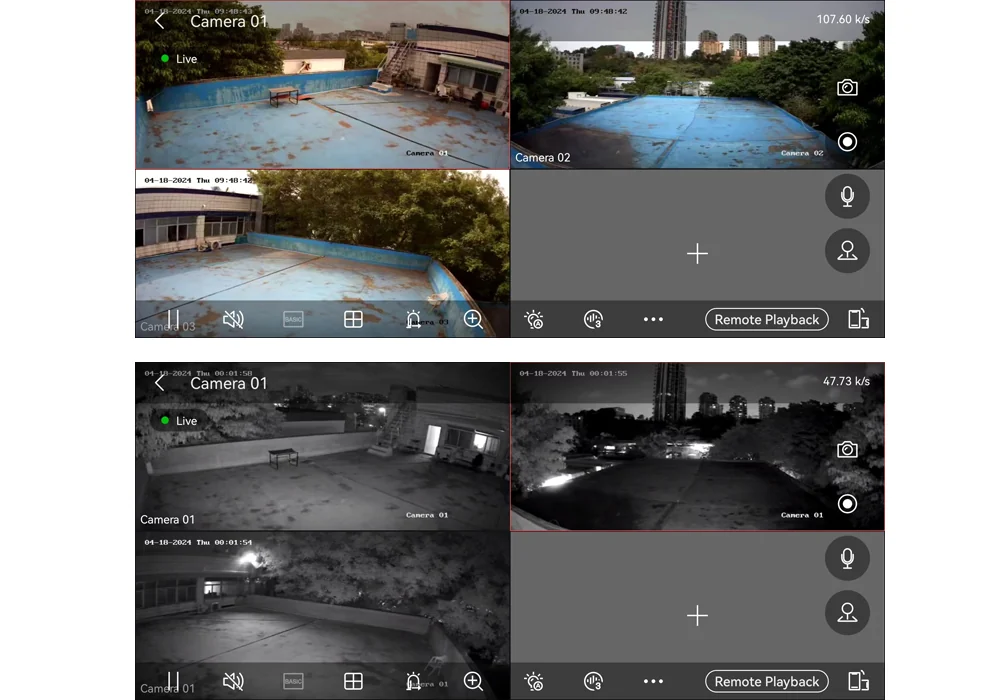
Hik-Connect screen showing Camera 01 and Camera 02 from the CS100 kit, with a four-pane layout in daylight and the same two views in infrared at night
Camera 01 and Camera 02 in Hik-Connect: two lenses, two cards, one account.

Two cameras, two cards, two timelines

Each lens records to its own card, so pulling a day's footage means pulling two cards or downloading twice. On a site with a security office watching a wall, that is the wrong shape — those sites want a recorder with one timeline, which is what the A3 build is for. On a site where the manager looks at the phone on a Friday, two independent cards are simpler and there is nothing in the box to fail.

Three things the fixed build does better than a PTZ

It never misses the first three seconds

Almost every incident clip is judged on how it starts: someone appearing at the fence line, a torch crossing the yard. A PTZ that was facing the other way catches the middle. Two fixed lenses hold their arcs permanently, so the first frame of the event is already recorded — that is the whole argument for giving up zoom.

Two infrared arrays are the reason this array is tight

Two bullets running their IR through a winter night draw close to 0.36 kWh a day with the router, against 0.26 kWh harvested in summer from this panel. It is the tightest pairing we sell and we say so: fit the 50 Ah pack, and take the 100 Ah if your site sits dark for a week at a time. The alternative — a bigger panel — is the BS200.

Two cards mean one failure is not a blackout

Each camera writes to its own 128 GB card, so a card dying costs one view and not the record. The flip side is that there is no single timeline: to see both cameras across one afternoon you either open Hik-Connect twice or pull both cards. For most sites that is a fair exchange; for a site with a security office watching a wall, it is not.

Questions

Questions

Do both cameras share one SIM card?

Yes. One 4G router in the box serves both cameras, so one data plan covers the kit. That is also why the uplink budget matters: two mainstreams at 4 Mbit/s is 8 Mbit/s and a site link will not hold it, so the app streams two sub-streams instead and you call a mainstream up when you need detail from one camera.

Can I add a third camera later?

Not on this box. The controller, the router and the 100 W array are sized for two. A third lens means the BS200 A3 build, which carries three on a 200 W array with a recorder — that is the upgrade path, and it is a different tower rather than an add-on.

What is the difference from the BS100 single-head build?

Same panel, same box, same 20 A controller. The BS100 puts one 30× PTZ head on the pole and can read a plate at a hundred metres; this one puts two fixed 105° lenses and holds two directions all the time but cannot zoom. Coverage or identification — pick the one your incidents are made of.

Is 128 GB per camera enough?

About three days of continuous 4 Mbit/s footage per camera, which sounds short and usually is not: switch to motion recording and a working site stretches it to several weeks. If you need continuous retention for a month, this is the wrong architecture — the recorder builds exist for exactly that.

Does the kit work without mains power at all?

Yes. The panel, the controller and the 12 V battery are the entire supply; the box has no mains input. Sites that do have power can still run it this way and skip the trenching, which is usually the larger cost.

Quote a CS100 two-camera build

Send the two directions you want held and the country of delivery. You get the lens spacing plan, the battery size for your latitude and a landed price.