T2 · Construction site · 4 × 8 MP PTZ

Four heads, and all four can reach

The same trailer, mast and battery as the GT70480M, with a different camera argument on top: four 8 MP 30× PTZ heads instead of one zoom and three fixed wide angles. It is the build for a compound where the interesting thing can happen on any side — and the one where the power budget, not the steel, decides what you can have.

  • 4 × 8 MP Sony 415 heads, each 3.2–96 mm with 30× optical zoom — 360° endless pan, 90° tilt
  • 900 W on three 300 W mono panels, charging 7,200 Wh of gel in four 12 V 150 Ah blocks
  • Every head reaches 100 m in infrared; at that range a 1.8 m person is 1,192 px tall
  • 2 TB SSD recorder in the box — about eleven days for four channels at 4 Mbit/s
  • 4G or 5G with a 12 dBi antenna, Hik-Connect app, free VMS for PC
  • Hand-cranked 6 m mast, 40 kg payload, level-8 wind rating, four manual legs, 15″ wheels
SZGOING T2 solar CCTV trailer in the studio: a white single-axle trailer, three tilted solar panels behind a raised telescopic mast carrying four PTZ camera heads

What changes when all four cameras zoom?

The wide shot stops being free. A fixed 2.8 mm bullet sees 90° at any distance and asks for 7 W; a 30× head sees 3.3° when it is zoomed in and asks for the same 7 W to sit still, more to move. Four zoom heads give you four long reaches instead of one, but nothing is watching 90° any more — you get the far corner, the gate and the road, and you get them one preset at a time. The honest summary: this build trades breadth for reach, and pays about twice the daily energy for it.

Specifications

Standard configuration

SpecificationDetail
SolutionT2
Cameras4 × 8 MP Sony 415 PTZ, 3.2–96 mm, 30× optical zoom
Pan / tilt0–360° endless pan, 0–90° tilt; 4 presets per head in the usual schedule
Night vision100 m infrared per head; colour in the near field under ambient light
CompressionH.265+
RecorderHikvision 2 TB SSD NVR in the box, four channels, no cloud fee
Recording time≈11 days for four channels at 4 Mbit/s; ≈23 days at 2 Mbit/s
Network4G LTE (EU/Asia/Africa, Americas, Australia band plans) or 5G; WiFi 2.4 GHz
RemoteP2P by device ID — Hik-Connect, free VMS for Windows
AlarmTwo red-blue beacons on the relay, switched from the app
Solar array3 × 300 W mono, 900 W total, ≥21.5% cell efficiency
Charge controlMPPT 24 V 40 A, ≥99% tracking
Battery4 × 12 V 150 Ah gel, 7,200 Wh, ≥80% usable — included
Power budget≈1.3 kWh a day for four heads, recorder and router; ≈2.4 kWh harvested at 3.5 peak-sun hours
MastHand crank, 6 m, 40 kg payload, level-8 wind rating
TrailerSingle axle, 15″ tyres, four manual legs, 50 mm ball or 70 mm ring
Operating range−35 to 60 °C; 6.5 h full charge from empty in full sun
DeliveryDDP by sea or rail with express option, door to door, 3–4 weeks
Server box400 × 250 × 500 mm

The table describes the standard build; the order datasheet confirms the final configuration.

Product video

Twenty seconds from one of the four heads

A street-side gate on a factory perimeter: a pedestrian walking the fence line, a boom barrier, cones, and a bus on the road behind. The head holds 1× and then goes to about 11×, which is the point where the far fence stops being texture. Factory footage with its own watermark and date. It is one head, not four at once — a four-way wall would need four of these side by side.

Factory footage; the cut and the re-encode are ours.

Product description

The fourth head is a power decision

Why four zoom heads change the array, the recorder and the way the site is watched.

A bullet and a PTZ are not the same instrument

The GT70480M mounts one 30× head and three 2.8 mm bullets, and that is a good answer: one direction gets the long reach, three get continuous wide cover that never misses the first second of an incident because nothing in them moves. The T2 keeps the trailer and changes the argument — four heads that all zoom, so no side of the compound is the one you cannot read.

A 1.8 m person at distance, and what each lens makes of it. Pixel height on a 3840 × 2160 sensor with 1.45 µm pixels: focal length × 1,800 mm ÷ distance ÷ 1.45 µm. Below about 40 px a person is a shape; a face needs 80–100 px between the eyes.

Distance2.8 mm bullet (fixed)96 mm head (30×)Frame width at 96 mm
50 m69 px2,383 px2.9 m
100 m35 px1,192 px5.8 m
150 m23 px795 px8.7 m
200 m17 px596 px11.6 m

Read the middle row: at 100 m the fixed bullet gives you 35 px, which is enough to say that something moved. The zoom head gives 1,192 px — you can describe the jacket. That gap is 34×, and it is the whole reason to pay for four moving heads instead of one.

What the fourth head does to the power budget

A parked head draws about 7 W; pulling it to a preset and holding the motor adds a few watts more. Four heads, the recorder and the router land near 53 W average, which is 1.3 kWh a day — more than double the 0.6 kWh of the mixed build on the same trailer. That number is why this configuration ships with 900 W of panel and 7,200 Wh of gel rather than the 200 W tower's hardware.

  • ≈2.4 kWh harvested at 3.5 peak-sun hours, against ≈1.3 kWh of load
  • ≈1.0 kWh harvested on a one-peak-sun December day — the pack covers the gap
  • ≈5.7 kWh usable in the gel blocks, so roughly two weeks of buffer
  • The array is three 300 W modules; the regulator is the same 24 V 40 A MPPT either way

The array is three modules rather than one, and that is a maintenance decision. A 300 W mono module weighs about 18 kg, so one person on a ladder can change one; lose a module and you keep 600 W, two thirds of the array, and the four heads keep running on a thinner margin instead of stopping. On a compound two hours from a depot, that is worth more than a cleaner cable run.
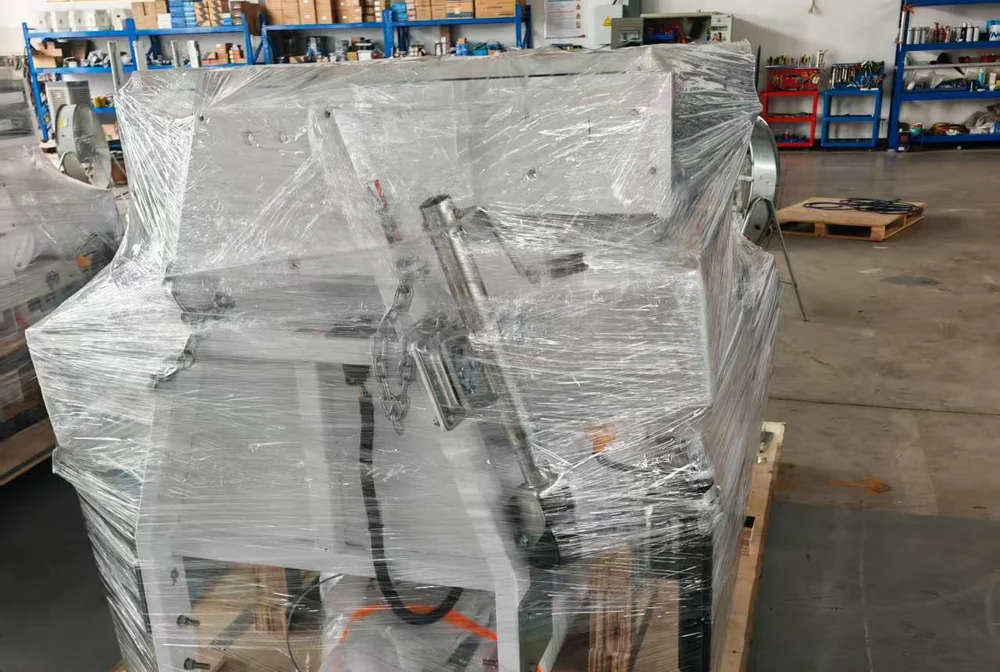
The T2 trailer wrapped in stretch film on a wooden pallet inside the factory, ready for export
Shipped on its pallet: mast down, panels folded, legs retracted.
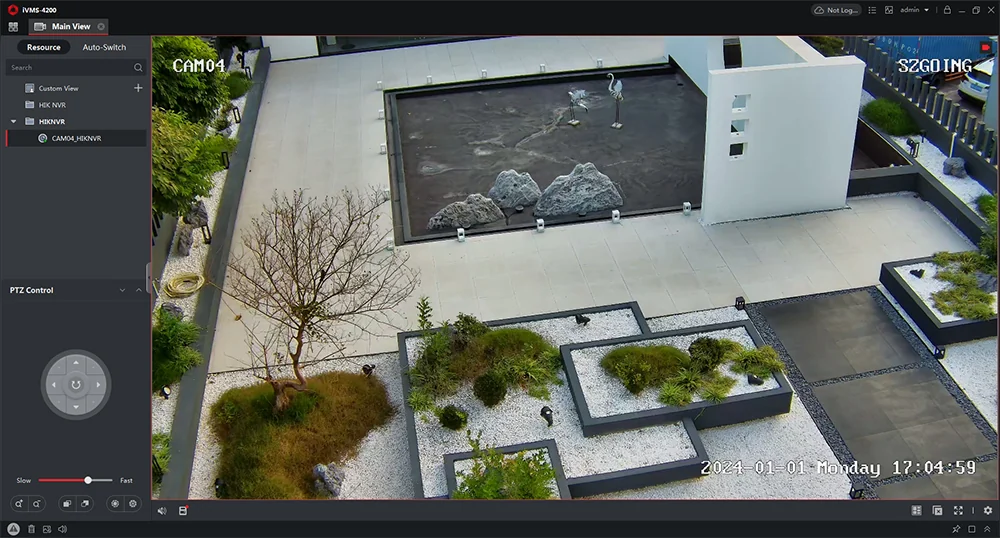
The iVMS-4200 client on a PC showing a live picture with the PTZ control panel on the left
One head on screen, PTZ held by the operator — the way four presets are set up.

One thing four heads cannot do

They cannot be four places at once, and this page should say so before a buyer finds out on site. A 96 mm shot is 3.3° wide: at 100 m that is 5.8 m of world. Four presets per head, 15 s dwell, 3 s travel, and the whole set is revisited roughly every 70 s. Someone who crosses a fence in eight seconds will be caught by the recorder if a head happens to be pointing there, and missed if it is not. Where that matters, the answer is a fixed camera in that direction — which is the mixed build, and the reason we still quote it more often than this one.

Three things the fourth head costs you

The gap between 2.8 mm and 96 mm is thirty-four times

At 50 m a fixed 2.8 mm bullet draws a 1.8 m person 69 px tall — enough to count people, not to recognise one. The same distance through 96 mm is 2,383 px, and the head still resolves a number plate at 100 m. Four heads that all zoom means four directions where that sentence is true, instead of one.

Four heads, twice the daily energy

Moving a head costs more than leaving it parked, and four of them pulled to four presets all day is a different load from one. Budget near 1.3 kWh a day against 0.6 on the mixed build. That is why the array is 900 W and the pack is 7,200 Wh: on this configuration the solar is not a feature, it is what makes the fourth head possible.

Three 300 W panels is a ladder decision

900 W spread over three modules of about 18 kg each is not the lightest way to build it, but it is the one a single person can service. Lose a module and you keep 600 W — two thirds of the array — and the four heads, the recorder and the regulator carry on with a thinner margin instead of going dark. On a site two hours from a depot that matters more than cable count.

Questions

Questions

Can four heads watch four directions at once?

They can record four channels at once, but they cannot hold four long shots at once. A head at 96 mm sees 3.3°, so a preset covers a doorway or a gate, not a side of the site. In practice each head tours its own presets — four positions at 15 s each plus about 3 s of travel is a round of roughly 70 s per head, so any single point is revisited about every 70 s. If you need a direction watched continuously, that direction needs a fixed camera, and that is the mixed build.

Is 4G enough for four 8 MP streams?

Not for four main streams. Four channels at 4 Mbit/s is 16 Mbit/s up, which a site 4G link rarely gives. The working setup is what Hik-Connect does by default: sub-streams to the phone, main stream on demand. The 2 TB SSD records the main stream locally, so the link only has to carry the view and the playback you ask for, not the archive.

What does the 30× actually resolve at 100 m?

A 1.8 m person is 1,192 px tall at 100 m through 96 mm on this sensor; a 520 mm plate is 344 px wide. Both are comfortable. At 150 m the person is 795 px and the plate 229 px — still readable, but now the frame is only 8.7 m wide and a moving car leaves it quickly. Beyond that distance you are buying atmosphere, not detail.

What happens in a northern winter?

Gel loses capacity in the cold — count on half of 7,200 Wh at −20 °C — and four heads do not use less energy because it is December. The arithmetic still closes: about 1.0 kWh harvested on a one-peak-sun day against 1.3 kWh of load, with the pack covering roughly 0.3 kWh a day from 5.7 kWh usable. That is about two weeks of buffer, which is why we do not repeat the brochure's three-day figure as if it were the real one.

Can I order it with one PTZ and three bullets instead?

Yes — that is the GT70480M, on the same trailer and the same mast. Take it if one direction carries the zoom and the other three only need to hold a wide view; you give up three long reaches and gain continuous coverage of three sides, and the daily load drops by half. The recorder and the array are sized for either.

Ask for a quote on the T2 trailer

Tell us the ground it will cross, whether four zoom heads or one plus three is right, and the delivery country. You get the towing weight, the array sized to your latitude and a delivered price.