
Pixels per degree, not megapixels
A camera's ability to identify someone has almost nothing to do with how many megapixels it advertises, because that number is spread over whatever the lens covers. Divide pixels by degrees and the comparison changes: 1920 across 76° is 25 px per degree, while 2304 across 120° is 19. Divide again by distance and you get pixels per metre of ground, which is the only figure that decides whether a face is a face.
| Camera | Horizontal view | Width at 10 m | 1.8 m person at 10 m | At 100 px |
|---|---|---|---|---|
| GT-S12, 1080p | about 76° | 15.5 m | 222 px | about 22 m |
| GT-Q5, 3 MP | 120° | 34.6 m | 120 px | about 12 m |
| GT-Q2, 3 MP | 120° | 34.6 m | 120 px | about 12 m |
Read the last two columns together and the trade is plain: this camera holds a usable face to nearly twice the distance, and shows you 45% of the width while doing it. A gate, a door, one lane up to a compound — that is a good deal. A yard with four approaches is not, and no amount of lens arithmetic fixes it.
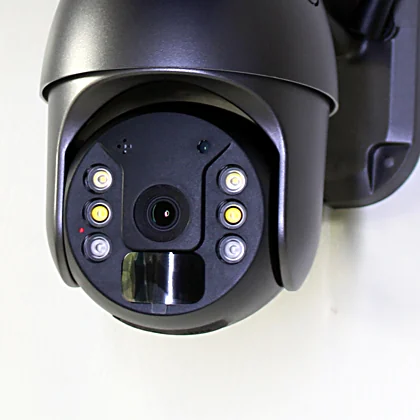
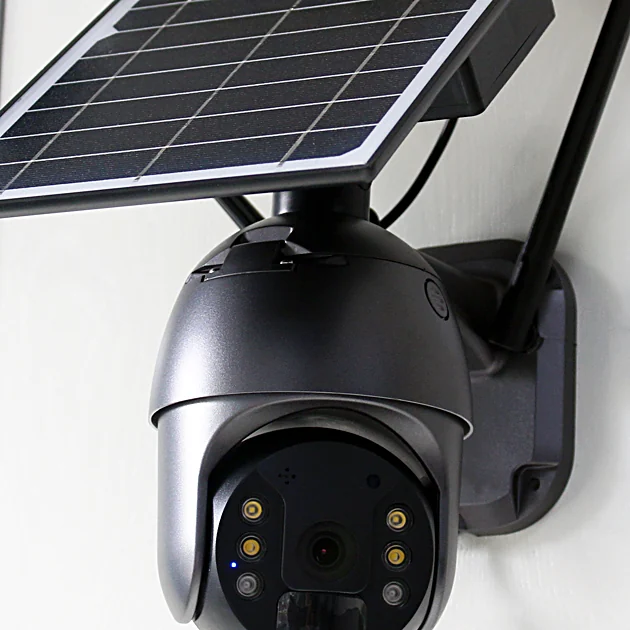
Sixty-six watt-hours, and a claim that does not add up
Six 18650 cells at 3,000 mAh and 3.7 V is 66.6 Wh, of which count about 53 usable because the controller stops before the cells are flat. The artwork says the 8 W panel fills that in 5–8 hours of sun. Eight watts across six hours is 48 Wh with perfect conversion and no losses, against a 66.6 Wh pack: the arithmetic says three good days from empty, not one. Where the 5–8 hour figure comes from is a pack that is already most of the way there, which is the normal state of a working solar camera and not the state it arrives in.
- 66.6 Wh installed, about 53 Wh usable (6 × 18650, 18,000 mAh)
- 8 W panel: about 28 Wh nominal at 3.5 peak-sun hours, about 22 Wh into the pack
- From flat to full: about three clear days, not the 5–8 hours on the artwork
- Standby and working draw are not published — that is the one number we cannot give you without asking the factory
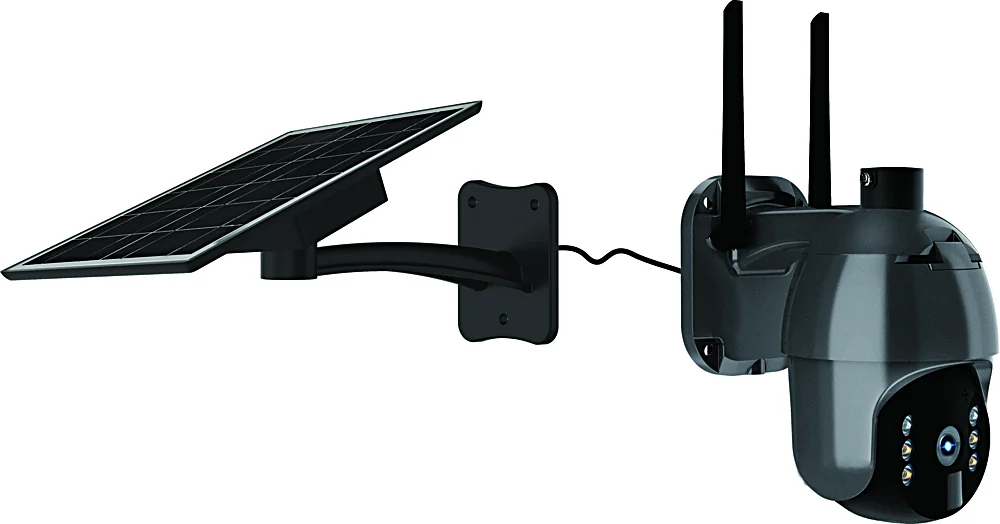
The AI filter is the interesting part, not the megapixels
PIR alone triggers on anything warmer than its background, which on a farm means cattle, dogs, a hot engine and, on a bad day, the sun coming out from behind a cloud. The listing pairs the PIR with an on-device human filter, so the trigger still comes from the sensor but the notification should wait for something that looks like a person. That is a different mechanism from the radar on the GT-Q5: radar measures motion and is blind to a branch that moves in the same way a person does, while a human classifier ignores the branch entirely but can miss a person in poor light. Neither is free, and this listing does not publish the filter's accuracy, so treat it as a reduction in nuisance alerts rather than a guarantee.
What we would tell you before you buy it
If the site needs to see everything at once, this is the wrong lens — the GT-Q5 covers 120° and the AOV build records continuously with two lenses. If it needs a plate at 100 m, that is the 100× dual-head. What this one does is put a recognisable person at 20 m on a 2 MP sensor and an 8 W panel, in a metal body that a customer will not notice on the wall — and it does it for less silicon than the rest of the range. Buy it for the doorway, not the yard.