GT-Q2 · Solar · 3 MP 4G PTZ

It sleeps, and that is the whole design

A 3 MP pan-tilt head, a 5 W panel bolted above it and 9,600 mAh in two 21700 cells: this is the small solar camera done the way it has to be done at this size. It does not record continuously. It sleeps at 0.03 W, wakes when the PIR sees heat, records, pushes a message and goes back to sleep. Everything that looks like a limitation on this page follows from that one sentence, including the honest answer to how long it lasts.

  • 3 MP at 2304 × 1296, 4 mm F2.0 lens, 120° wide — 19 px per degree across the frame
  • 5 W monocrystalline panel on a hinged bracket; 3 m type-C cable so the panel can sit apart
  • 9,600 mAh in two 21700 cells — about 35.5 Wh, roughly a fortnight of PIR duty without sun
  • 355° pan, 120° tilt, 10–30°/s; four IR array LEDs to 30 m, full colour day and night
  • PIR to 12 m wakes it, records to a card and pushes to the app; sleep draw 0.03 W
  • 128 GB micro SD or cloud; two-way audio; five 4G band builds or a 2.4 GHz Wi-Fi version
Black 3 MP solar PTZ camera with a 5 W solar panel on a hinged bracket above the head, four infrared LEDs around the lens

What does a 3 MP solar camera actually do all day?

Nothing, and that is the point. It sleeps drawing 0.03 W until the passive infrared sensor sees a warm body move within about 12 m; then it wakes, records to the card, pushes a notification and returns to sleep when the alarm ends. There is no continuous recording and no pre-roll: the clip starts at the trigger, not before it. On a daily duty of thirty events and twenty minutes of live view it uses about 2.2 Wh, which the 5 W panel replaces in two or three days of ordinary sun.

Specifications

Standard configuration

SpecificationDetail
ModelGT-Q2 (the spec sheet is also printed Q5PRO; it covers the 3 MP T31ZL and the 1440P T31ZX builds)
Sensor3 MP CMOS, 2304 × 1296, Ingenic T31ZL
Lens4 mm F2.0, 120° horizontal, low-light; 4× digital zoom
StreamsMain 3 MP at 15 fps, sub 640 × 360 at 15 fps
CompressionH.265, MP4 files
Night vision4 array infrared LEDs, 30 m; full colour day and night
Pan / tilt0–355° pan, 0–120° tilt; 10–30°/s pan, 8–25°/s tilt
DetectionPIR, up to 12 m, wakes the camera and starts the recording
Power drawSleep 0.03 W; working 1.3 W by day, 3 W at night
Solar panel5 W monocrystalline on a hinged bracket, 3 m type-C cable
Battery2 × 21700, 9,600 mAh, about 35.5 Wh
StorageMicro SD up to 128 GB; cloud storage supported
AudioBuilt-in microphone and speaker, two-way audio, G.726/AAC
Network4G LTE nano SIM in five band builds — Europe, America, Australia, Japan, South-East Asia — or 2.4 GHz Wi-Fi
AppiCam+ on the factory sheet, UBOX on the Alibaba listing; ask which firmware you get
InputDC 5 V 2 A, type-C
RatingIP65, ABS fire-retardant housing, vandal-resistant
Temperature−20 to 60 °C, 10–80% RH non-condensing
Size / weight220 × 150 × 109 mm, 1.4 kg
WarrantyOne year

The table describes the standard build; the order datasheet confirms the final configuration.

Product description

The night it cannot survive

The arithmetic behind a five-watt panel, and the one habit that empties it.

What 120° buys, and what it costs

A 4 mm lens on a 3 MP sensor spreads 2,304 pixels across 120°, which is 19.2 px per degree. That is the number that decides whether a face is a face. At 10 m a 1.8 m person covers about 10.3° and lands on 198 px; at 20 m it is 99 px; at 30 m, where the infrared gives up, 66 px. Recognition of a stranger is comfortable to about 15 m; identification — the face you could pick out of six — really wants 80–100 px across the eyes, which is closer than 20 m.

DistancePerson heightFrame widthWhat it is good for
5 m396 px17.3 mFace and clothing
10 m198 px34.6 mRecognise a person you know
20 m99 px69.3 mRecognise a stranger, not identify
30 m66 px103.9 mSomething moved, and roughly what

Read the last column, because that is what you are buying: at 30 m this camera watches a hundred metres of fence line at once. No optical zoom does that, and no 30× head does it either — it would need four presets and a minute to sweep the same ground. Wide is the feature, not a compromise.

The pack, the panel, and the habit that kills it

Two 21700 cells give 9,600 mAh at 3.7 V, which is 35.5 Wh; count 28 Wh usable. Sleeping costs 0.03 W, so a quiet day is under a watt-hour. Thirty PIR events of twenty seconds and twenty minutes of live view come to roughly 2.2 Wh, which a 5 W panel replaces in two or three ordinary days — and in December, at one peak-sun hour, it is about 3.5 Wh in against 2.2 out. It survives winter, but only just, and only if nobody leaves the app open.

  • ≈35.5 Wh in the pack, ≈28 Wh usable (2 × 21700, 9,600 mAh)
  • ≈2.2 Wh a day at light duty: sleep, thirty triggers, twenty minutes of viewing
  • ≈9 h of continuous night streaming — less than one autumn night
  • 5 W panel: ≈17.5 Wh nominal at 3.5 peak-sun hours, ≈12 Wh into the pack

That last line is the design constraint, and it is worth writing on the box: the camera is not a live-view camera. Watching a feed costs 3 W at night, and the whole pack holds nine hours of it. Someone who checks the view for an hour every evening in November is taking 3 Wh a day out of a 3.5 Wh budget. Check it in daylight, or accept that the third cloudy week is when it stops answering.
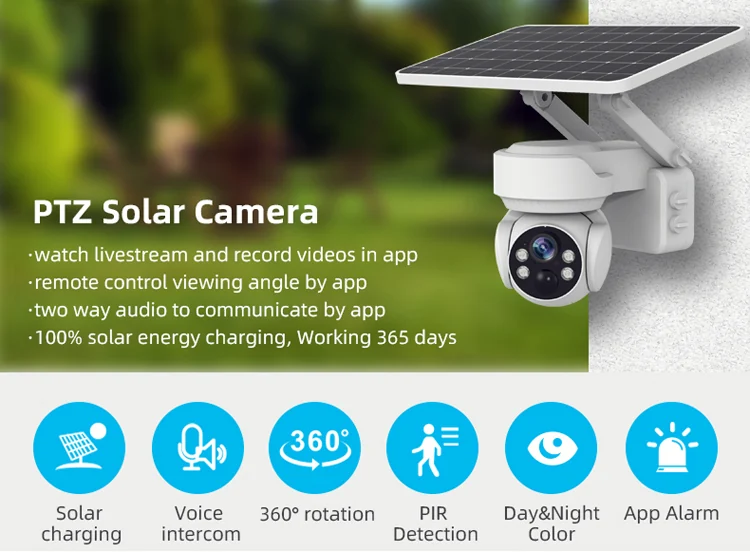
Six icons from the factory sheet: solar charging, voice intercom, 360° rotation, PIR detection, day and night colour, app alarm
The six claims the factory makes, all of which this page tests rather than repeats.
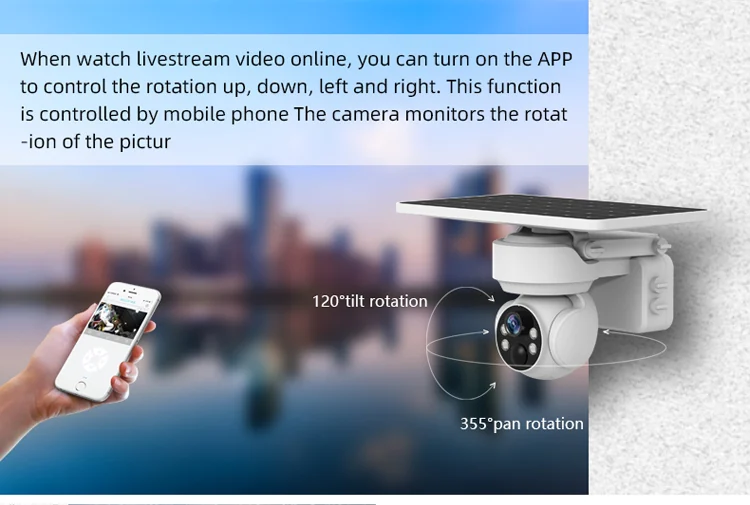
The camera shown from the side with the 355° pan and 120° tilt arcs drawn on, and a hand holding a phone with the live view
355° pan and 120° tilt: the arcs are real, and the phone is how you steer them.

Where the five watts show up

A 5 W panel is small enough that the mounting angle matters. Flat on a bracket under an eave in December, it will collect a third of what the same panel collects tilted at the local latitude — and this camera has no second panel to make up the difference. The bracket is hinged for exactly this reason: set it to the winter sun angle, not the summer one, and leave it. The 3 m type-C cable exists so the panel can go on the sunny side of a wall while the camera watches the shaded one.
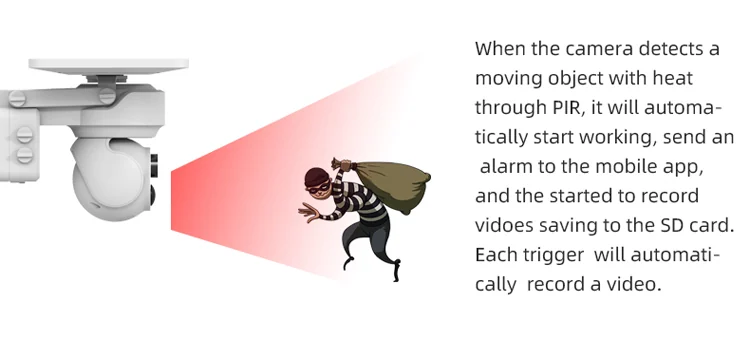
The PIR cone drawn from the camera to a figure crossing the frame, with the notification text beside it
PIR to 12 m: the camera is asleep until something warm crosses that cone.

What we would tell you before you buy it

If you need the seconds before an event, this is not the camera — take the AOV build, which records continuously and pays for it with a bigger panel. If you need to read a number plate at 100 m, it is not this camera either; that is the 100× dual-head. What this one does better than either is cover a hundred metres of fence for a fortnight on five watts and a card, with no cable, no router and no subscription. Buy it for that, and do not expect it to be the other two.

Three things the price does not buy

Nineteen pixels per degree, and nothing moves but the head

There is no optical zoom here, only 4× digital — which crops, it does not resolve. A 1.8 m person at 10 m is about 198 px tall; at 20 m about 99 px, enough to recognise someone you know; at 30 m, the limit of the infrared, about 66 px. That is a fair trade for 120° of coverage, but it is not the same instrument as the 30× head on the site towers.

The clip starts at the trigger, not before it

PIR wake is why this camera costs what it costs and why it runs on five watts. It is also why the first seconds are missing: the subject is already in frame when recording begins. If the approach matters — a vehicle arriving, someone walking the fence line — the answer is an always-on build, and we will say so rather than sell you this one twice.

IP65, not IP66 — and where that shows

The housing is sealed to IP65: rain from any direction is fine, a hose aimed at the hinge and the panel seam is not. The towers are IP66 for that reason. Mount it under an eave or with the panel tilted, keep the cable gland pointing down, and the difference stops mattering.

Questions

Questions

Does it record before the PIR fires?

No. The camera is asleep when nothing is happening, so the recording begins at the trigger. Expect the first one to two seconds of an approach to be missing, and expect the clip to open with the subject already on their way through the frame. If that gap is unacceptable, this is the wrong build and the AOV camera is the right one.

How many days will it run with no sun at all?

About a fortnight at a light duty — roughly 2.2 Wh a day against 28 Wh of usable capacity. Heavy duty cuts that quickly: an hour of live view every evening plus eighty triggers puts you near 5 Wh a day, so a week. The number to watch is not the battery, it is how often someone opens the app.

Can I watch it live all night?

No — and this is the most common way these cameras get returned. Working draw at night is 3 W, so 28 Wh of usable capacity is about nine hours of continuous streaming. An autumn night is twelve. You can watch, then it goes dark before dawn, and the panel needs two days to put it back.

Which SIM does it take, and will it work here?

A nano SIM, and the radio is built for one region: Europe (B1/B3/B5/B7/B8/B20/B38/B40/B41), America (B2/B4/B5/B12/B13/B14/B25/B26/B41/B66/B71), Australia (B1/B2/B3/B4/B5/B7/B8/B28/B40/B66), Japan (B1/B3/B8/B18/B19/B26) or South-East Asia. Name the country on the order; a European build will not register on an American tower. There is also a 2.4 GHz Wi-Fi version for sites that have a router.

Black or white, and which app?

Same build, same electronics, chosen as an option on the order — black suits a dark wall or a tree, white suits render and painted concrete. The app is the one thing to pin down: the factory sheet says iCam+, the listing says UBOX. Both are the same application under different branding, but ask which firmware your batch ships with, because the QR code in the carton is tied to it.

Ask for a sample of the GT-Q2

Tell us the country, whether it is 4G or the Wi-Fi version, and the colour. You get the band build that matches your SIM, a duty-cycle estimate for your latitude, and the price for one piece or a carton.