GT-LPR50M-150 · ANPR · 5 MP · 150 km/h

The road head: 150 km/h, and nothing in the cabinet

A box camera on a bracket, a 5–50 mm motorised lens and a neural processor that reads the plate before the picture ever leaves the housing. Wire it with one Cat5e, give it 12 V, and the cabinet that used to hold a recognition PC holds nothing at all. This is the build for a road, a checkpoint or a site entrance where vehicles arrive fast and the plate is forty metres away.

  • Sony Exmor 1/2.7″ 5 MP starlight CMOS; HiSilicon quad-core 900 MHz with a 1 TOPS CNN engine
  • 5–50 mm motorised zoom — a 520 mm plate lands about 395 px wide at 40 m
  • 3200 × 1800 still for the plate, 1080p25 H.265 for the operator, 25 fps
  • Two lanes, ±65° left and right, 60° up and down, reading 100+ countries with no samples
  • TF slot to 128 GB for captures; ONVIF so a Hikvision, Dahua or Uniview recorder takes the stream
  • Six fill lights on 24 h, on a timer, or on the light sensor — plus 2 relay outputs and 2 × RS485
SZGOING GT-LPR50M-150 ANPR camera on its wall bracket, a white box camera with a black faceplate carrying six fill lights around the lens

Why does the recognition have to be in the camera?

Because of what a PC in a cabinet costs over five years: a fan, a Windows licence, an antivirus renewal, a hard disk, and somebody to drive to the site when it stops. The recognition here runs on the camera's own 1 TOPS neural engine and the only storage it needs is a TF card. The desk software still exists — Windows and Linux SDKs, and TCP, HTTP and MQTT APIs — but it is optional, not the thing that keeps the gate working.

Specifications

Standard configuration

SpecificationDetail
ModelGT-LPR50M-150 (5 MP); GT-LPR30M-150 (3 MP) on the same body
ProcessorHiSilicon neural processor, quad-core 900 MHz + CNN engine, 1 TOPS
SensorSony Exmor 1/2.7″, 5 MP starlight CMOS
Video1920 × 1080 at 25 fps, H.265 High Profile, 256 kbps–8 Mbps
Capture3200 × 1800 still per event, stored as JPEG
Speed rating150 km/h
Lanes2
Read distance5–40 m, automatic capture
Reading angle±65° horizontal, 60° vertical
Recognition≥98% overall, >90% with zero samples, >99% after on-site learning
Plate types100+ countries; number, colour, type and width; anti-counterfeit check
Vehicle dataModel, body type, colour and other structured attributes
Lens5–50 mm motorised zoom
Fill light6 built-in LEDs, adjustable; 24 h, timed or light-sensor trigger
TriggerVideo recognition, virtual loop, ground-coil line crossing, optional radar
Outputs2 relay outputs (barrier, gate, alarm)
Inputs2 opto inputs, or 2 level-signal inputs
Serial2 × RS485, half-duplex, to 115200 baud
Network1 × RJ45 10/100 Mbps adaptive; ONVIF
Storage1 × TF slot, 128 GB maximum
InterfacesTCP, HTTP, MQTT; SDK for Windows and Linux (VB, C#, C++, Delphi)
Power12 V DC, single tail
Operating range−30 to 60 °C, IP66 housing
In the boxCamera, bracket, manual

The table describes the standard build; the order datasheet confirms the final configuration.

Product video

What the recogniser writes down

Twenty-eight seconds of the desk software at work on a two-lane road: the plate boxed in the live picture, the same plate enlarged underneath, and a record row added with the time, the lane and the confidence. Factory footage, watermark and timestamps left in.

Factory footage; the trim and re-encode are ours.

Product description

A road camera that does its own arithmetic

What 5 MP and 50 mm mean at forty metres, and what has to be true for the plate to be read.

The two numbers on the datasheet that are not marketing

Every ANPR page quotes a speed and a distance. Ours says 150 km/h and 5–40 m, and those two figures are really one figure: the width of the frame at the far end. Zoomed to 50 mm on this sensor the picture is 4.2 m wide at 40 m. A car doing 150 km/h covers 41.7 m every second, so it is inside that 4.2 m window for 0.10 seconds — two and a half frames at 25 fps. That is the whole challenge of a fast road, and it is why the specification stops at two lanes: three would need a wider frame, a wider frame means fewer plate pixels, and fewer plate pixels is where recognition turns into guessing.

DistancePlate width at 50 mmFrame width at 50 mmFrames at 150 km/h
5 m3,157 px0.53 m0.3
10 m1,579 px1.05 m0.6
20 m789 px2.11 m1.3
30 m526 px3.16 m1.9
40 m395 px4.21 m2.5

Read the table the other way and it is the argument for the whole product: at 20 m the plate is 789 pixels wide and the car is in frame for 1.3 frames; at 10 m it is 1,579 pixels and 0.6 frames. The camera has to trigger while the vehicle is still approaching, not when it fills the picture. That is a trigger problem, and it is solved with the virtual loop and the line crossing — both of which are configured in the browser, not in a PC.
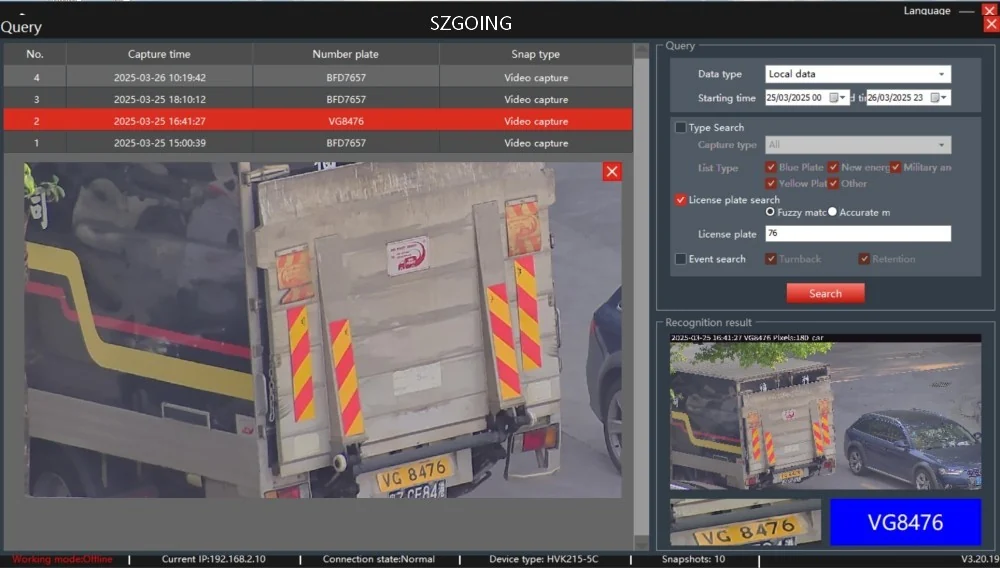
ANPR software screenshot: a box lorry with reflective rear markings crossing two lanes at dusk, the plate VG3476 boxed and enlarged beneath
Dusk on a two-lane road: the plate boxed, the same plate enlarged, and a record row with the time and the confidence.
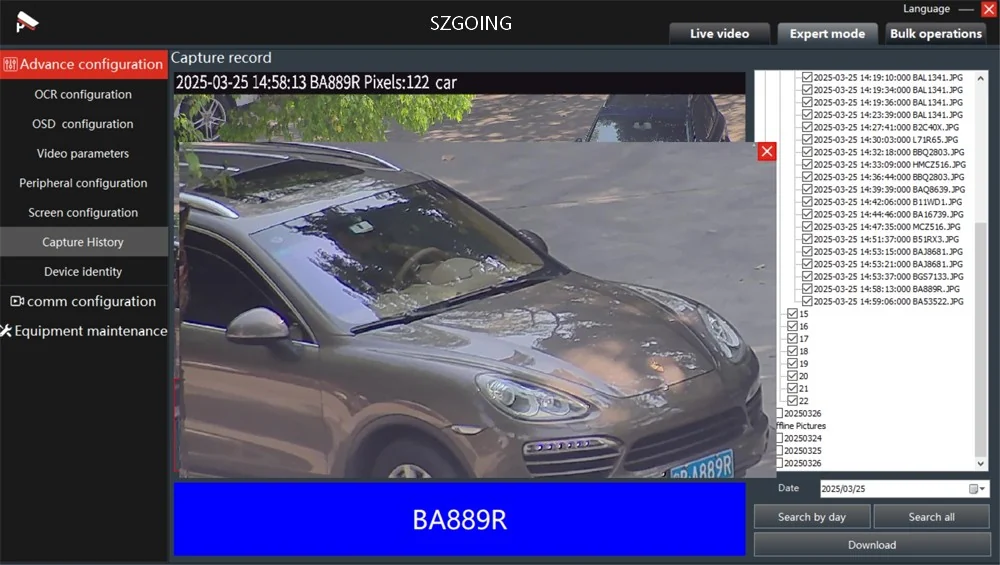
The same software showing a saloon captured in daylight with the plate BA889R enlarged in a blue band and the record list beside it
Daylight, same camera: the capture card and the log on the right, which is what the morning shift actually reads.

What is inside the box, and what is not

Inside: a Sony Exmor 1/2.7-inch starlight sensor, a HiSilicon quad-core at 900 MHz with a 1 TOPS CNN engine, six fill lights, a 5–50 mm motorised lens, two relay outputs, two opto inputs, two RS485 ports and a TF slot. Not inside: a hard disk, a battery, a fan on a CPU, or anything that needs a licence key. The camera writes 3200 × 1800 stills per event and streams 1080p25 H.265 at up to 8 Mbps to whatever recorder you already own — ONVIF is there so a Hikvision, Dahua or Uniview NVR takes the stream without a plugin.

Who should not buy this

If the plate arrives at six metres and stops, this camera is more than the job needs: the 4 MP build reads the same plate with a wider window and costs less. If there is no cable at the post, take the 4G version — same lens, same sensor, a modem instead of the Ethernet port. And if what you actually want is a camera that watches a compound rather than a log of plates, this is the wrong category: a site tower gives you recording and an alarm for less.

Three things this build buys you

Forty metres is a lens decision, not a marketing one

A 520 mm plate at 40 m through 50 mm of glass on a 1/2.7-inch sensor covers about 395 pixels — comfortably enough for OCR. At 22 mm the same plate is 110 pixels, which is where recognition starts guessing. The motorised 5–50 mm range is why this head reads a road and the 4 MP build reads a barrier.

Two and a half frames is the whole challenge

Zoomed to 50 mm at 40 m, the frame is 4.2 m wide. A car at 150 km/h crosses it in 0.10 s, which at 25 fps is two and a half frames — so the trigger, not the algorithm, is what you are paying for at this speed. That is also why the datasheet stops at two lanes: a third lane would need a wider frame and would give you fewer plate pixels.

The log survives the network

Captures go to the TF card as they happen: plate, time, lane, JPEG. A 128 GB card holds tens of thousands of records, so a fortnight of gate traffic is on the camera itself. Nothing about that depends on the internet, on a subscription, or on somebody's laptop being switched on.

Questions

Questions

Do I need a computer at the gate?

No. The camera recognises, stores and decides on its own board, and the relay that opens the barrier is on the camera. The Windows/Linux SDK and the TCP, HTTP and MQTT APIs are there for integrators who want the records in their own system — they are not needed for the camera to work, and if your network dies the gate still opens for a whitelisted plate.

Will a 5 MP sensor really read a plate at 40 m at night?

At 40 m the plate is about 395 pixels wide, and the six fill lights are what make that possible after dark — they are on the same board as the sensor and their brightness is set per scene. What we will not claim is that any camera reads at 40 m in a monsoon: at that distance you are one lens setting away from a 4.2 m frame, so a plate that is wet, tilted or half behind a tow bar is where the 98% figure stops being the useful number. Send us a night photo from your post and we will tell you what to expect.

What is the difference between this and the 4 MP build?

Two things, and both are physical. The 5 MP sensor gives 3200 × 1800 stills instead of 2034 × 1296, and the lens goes to 50 mm instead of 22 mm. Between them they are what lets this camera read at 40 m; the 4 MP build is happier at four to eight metres. If your post is 30 m from the plate, this is the one. If it is six, the 50 km/h build does the same job for less and triggers more easily.

Can it open a barrier and keep a whitelist?

Yes. Load the list on the camera, set which relay closes for how long, and the plate is compared locally: two relay outputs, two inputs for a loop or radar, and two RS485 ports at 115200 for a barrier controller that wants a serial command instead of a contact. Unlisted plates are still captured and logged, with the picture, so the log answers the argument afterwards.

Is the radar speed version a different camera?

No — radar speed measurement is an option on the same body, and it is what you fit when the job is enforcement rather than access: speed and capture, with the reading written into the record. Without it the camera still captures on a virtual loop or a line crossing, and still records the vehicle attributes.

Quote a GT-LPR50M-150

Tell us the distance from the post to the plate, how many lanes, the speed vehicles arrive at and whether there is a cable at the post. You get the lens setting, the relay wiring and a delivered price.