GT-4G-LPR50M-150 · ANPR · 5 MP · 4G

The road head with the cable taken away

Same sensor, same 5–50 mm lens, same recogniser on the same board as the wired build — with the Ethernet port replaced by a 4G/3G module and two antennas. What that changes is not how the plate is read; it is who has to dig a trench, and what your SIM bill looks like at the end of the month.

  • 5 MP Sony Exmor 1/2.7″ CMOS, 5–50 mm motorised zoom, 150 km/h, two lanes
  • 4G/3G module with two antennas — EU/Asia/Africa, Americas and Australia band plans
  • Recognition and the barrier relay stay inside the camera; 4G carries the record and the view
  • 64 GB of captures on the TF card instead of 128 GB
  • 3200 × 1800 still per event, 1080p25 H.265 video, ONVIF
  • Two relay outputs, two inputs, 2 × RS485 — a gate opens with the uplink dead
SZGOING GT-4G-LPR50M-150 ANPR camera face on, with two tall black whip antennas on top of the housing and four fill lights around the lens

What does 4G actually change?

Not the reading. The plate is recognised, compared against the whitelist and turned into a relay contact on the camera's own board, exactly as in the wired build — a car with a listed plate gets in whether or not the modem has a signal. What 4G changes is the two things you would otherwise need a cable for: watching the gate from somewhere else, and collecting the records. And it changes the card: 64 GB instead of 128, because the uplink, not the storage, is what you will be managing.

Specifications

Standard configuration

SpecificationDetail
ModelGT-4G-LPR50M-150 (5 MP); GT-4G-LPR30M-150 (3 MP) on the same body
ProcessorHiSilicon neural processor, quad-core 900 MHz + CNN engine, 1 TOPS
SensorSony Exmor 1/2.7″, 5 MP starlight CMOS
Video1920 × 1080 at 25 fps, H.265 High Profile, 256 kbps–8 Mbps
Capture3200 × 1800 still per event, stored as JPEG
Speed rating150 km/h
Lanes2
Read distance5–40 m; 5–50 mm motorised zoom
Reading angle±65° horizontal, 60° vertical
Recognition≥98% overall, >90% with zero samples, >99% after on-site learning
Plate types100+ countries; number, colour, type and width; anti-counterfeit check
Vehicle dataModel, body type, colour and other structured attributes
Fill light6 built-in LEDs, adjustable; 24 h, timed or light-sensor trigger
TriggerVideo recognition, virtual loop, ground-coil line crossing, optional radar
Network4G/3G, two antennas; band plans for EU/Asia/Africa, the Americas and Australia. No Ethernet port on this build
Outputs2 relay outputs (barrier, gate, alarm)
Inputs2 opto inputs, or 2 level-signal inputs
Serial2 × RS485, half-duplex, to 115200 baud
Storage1 × TF slot, 64 GB maximum
InterfacesTCP, HTTP, MQTT; SDK for Windows and Linux (VB, C#, C++, Delphi)
Power12 V DC, single tail; SIM in a Nano socket inside the housing
Operating range−30 to 60 °C, IP66 housing
In the boxCamera, bracket, two antennas

The table describes the standard build; the order datasheet confirms the final configuration.

Product video

What the recogniser writes down

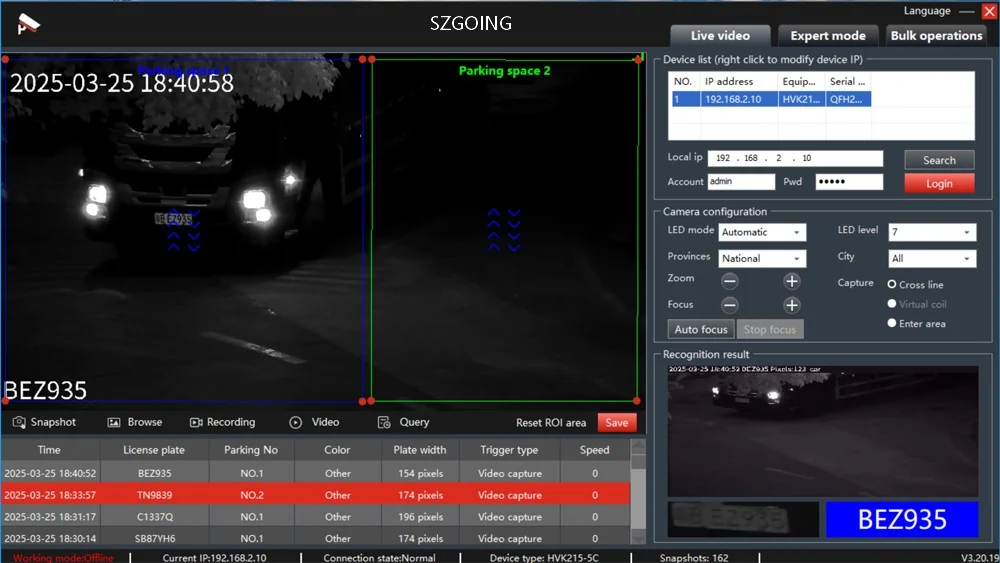
The same desk software on the same two-lane road: the plate boxed in the live picture, the plate enlarged beneath, and a row added with the time, the lane and the confidence. Over 4G this is what arrives at the office — the pictures, not the decision.

Factory footage; the trim and re-encode are ours.

Product description

A road camera with a modem instead of a duct

What the 4G build does the same, what it does differently, and how to size the SIM.

Trenching is the expensive part of ANPR

Ask what a gate camera costs and the camera is rarely the number that hurts. Digging a duct from the nearest building to the post, restoring the surface, and doing it on somebody else's land is civil work, and it is priced by the metre. This build exists to delete that line from the quote. The recognition, the whitelist and the relay do not need the network at all; only the remote view and the record upload do, and 4G covers both.

What you take on instead is a data plan and a signal survey. Two antennas, 12 dBi on the tower builds and the two whips here, and a site visit that establishes which of the three band plans you need. Get that wrong and the camera is a very expensive plate camera with no remote view; get it right and nobody thinks about the network again.
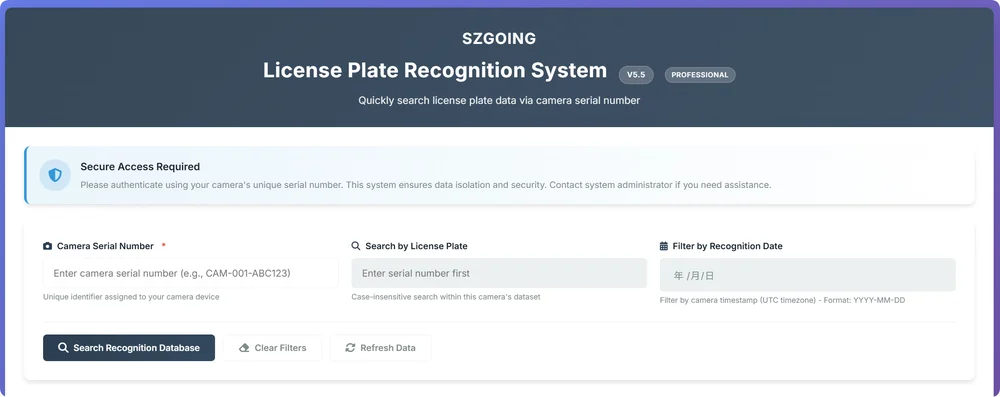
The ANPR web console landing page, served from the camera over 4G: a sign-in card for the License Plate Recognition System
The console is served by the camera itself — over 4G it opens in a browser like any other page.
Night capture over 4G: a car approaching with headlights on, its plate enlarged and a warning row in the record list
The same night, over a phone link: headlights, the boxed plate, and the row that says a vehicle was seen.

How to size the SIM without guessing

Count the vehicles, not the hours. A record row with a plate crop is about 30 KB; a full 3200 × 1800 still is the better part of a megabyte. A yard with a hundred movements a day is under 100 MB a month on crops and about 3 GB on full stills. A road with a thousand is 1 GB or 18 GB. Then add the live view, which is a video stream and behaves like one: minutes of main-stream viewing cost more than a day of records.

Who should not buy this

Anyone with a cable already at the post: the wired build is cheaper, has twice the card and no plan to pay. Anyone whose site also has no power: the solar tower carries this head on 200 W of panel. And anyone whose site is inside a building's WiFi footprint — a bridge is cheaper than a modem, and the wired head is the right purchase.

Three things to know before the SIM

The data plan is your design decision, not the camera's

The record row — plate, time, lane, confidence — is a few hundred bytes. The picture is not: a 3200 × 1800 JPEG is the better part of a megabyte, and a thousand vehicles a day at full size is around 18 GB a month. Send the log with plate crops instead and the same thousand costs about a gigabyte. Decide which one you want before you buy the SIM, because the camera will do either.

The barrier does not wait for the network

Whitelist on the camera, two dry-contact relays, two inputs for a loop or radar, RS485 for a controller that wants a command. All of it local. A site whose 4G drops on a Friday afternoon still lets residents in all weekend, and the log is intact when the link comes back — which is the difference between 4G here and a cloud-dependent reader.

Half the card, and why that is fine

This build takes 64 GB rather than 128, because the uplink is the constraint you will manage, not the archive. 64 GB is still tens of thousands of captures with their rows — months of a gate's traffic, or a year of a quiet road — and the card is a single swap when it does fill.

Questions

Questions

How much data does it use in a month?

That is a function of how many vehicles pass and whether you push pictures. A thousand vehicles a day at a 30 KB plate crop is about 1 GB a month; the same thousand at full 3200 × 1800 size is nearer 18 GB. Live viewing adds the video stream on top, which is why most sites watch the substream on a phone and pull the main stream only when something needs explaining. We can size the plan with you once you know the traffic count.

What happens when the SIM runs out of credit?

Recognition carries on, the relay keeps opening for whitelisted plates and captures keep landing on the card. You lose the remote view and the notifications until the SIM is topped up, and the records that arrived in the meantime are still there. That is the argument for a contract SIM rather than a prepaid one on a gate that matters.

Can I use WiFi instead of 4G?

Not on this build — the module is cellular only. If the site has WiFi at the post, the wired build is the better answer: it is cheaper and the link is more reliable than a bridge. The two solar towers carry both 4G and 2.4 GHz WiFi, because an off-grid site may have either.

Which bands, and will it work in my country?

Three band plans: Europe, Asia and Africa (FDD B1/3/7/8/20, TDD B38/40/41); the Americas (FDD B1/2/4/12/13/17); and Australia (FDD B1/3/5/7/8/20 with 700 MHz optional, TDD B38/39/40/41). Tell us the country and the carrier at the order and we set the build and test the SIM before it ships — a 4G camera that arrives on the wrong band is a camera that arrives broken.

Does the 4G add delay to opening the barrier?

No, because the barrier is not in that loop. The plate is compared and the relay closes on the camera's board, so the delay between a car stopping and the barrier lifting is the same as on the wired build. What 4G delays is the record arriving at your office, which is measured in seconds and does not hold up a queue.

Quote a GT-4G-LPR50M-150

Tell us the country, the carrier you intend to use, how many vehicles pass a day and whether you need pictures at the office or just the log. You get the band build, a data estimate and a delivered price.