GT-LPR40M-50 · ANPR · 4 MP · 50 km/h

For a plate that arrives at walking pace

A barrier is not a road. The plate comes at you from four to eight metres, at 10 to 20 km/h, and then it stops and waits. That geometry does not want a 50 mm lens or a 3200-pixel still — it wants a 6–22 mm zoom, a sensor that already puts 240 pixels across the plate at six metres, and two relays that close before the driver has reached for the ticket.

  • 4 MP Sony Exmor 1/2.7″ CMOS, 2034 × 1296 capture stills, 1080p25 video
  • 6–22 mm motorised zoom — 736 px across a 520 mm plate at 6 m, 110 px at 40 m
  • 50 km/h rating, which at 22 mm means seventeen frames in the window, not two and a half
  • Two relay outputs for barrier and gate, two inputs for a loop or radar, 2 × RS485
  • Whitelist on the camera: a listed plate closes the relay with no network involved
  • TF slot to 128 GB, ONVIF, SDK for Windows and Linux, MQTT and HTTP APIs
SZGOING GT-LPR40M-50 ANPR camera, three-quarter view: white box housing with a black faceplate of four fill lights around the lens

Why 4 MP and not 5 for a barrier?

Because at six metres there is nothing left for the extra pixels to buy. A 520 mm plate through 22 mm of glass on this sensor is already 736 pixels wide — five times what the recogniser needs to read it — so a bigger sensor would not change a single read at that distance. What it would buy is reach at 40 m, and reach is not the problem a barrier has. What a barrier does need is a wide window and relays that fire fast, which is where the money went instead: a 6–22 mm lens that keeps the gate apron sharp, and two dry contacts that close on a whitelisted plate without asking a server.

Specifications

Standard configuration

SpecificationDetail
ModelGT-LPR40M-50 (4 MP)
ProcessorHiSilicon neural processor, quad-core 900 MHz + CNN engine, 1 TOPS
SensorSony Exmor 1/2.7″, 4 MP starlight CMOS
Video1920 × 1080 at 25 fps, H.265 High Profile, 256 kbps–8 Mbps
Capture2034 × 1296 still per event, stored as JPEG
Speed rating50 km/h
Lanes2
Read distance5–40 m; comfortable band for this lens is 4–15 m
Reading angle±65° horizontal, 60° vertical
Recognition≥98% overall, >90% with zero samples, >99% after on-site learning
Plate types100+ countries; number, colour, type and width; anti-counterfeit check
Vehicle dataModel, body type, colour and other structured attributes
Lens6–22 mm motorised zoom
Fill light6 built-in LEDs, adjustable; 24 h, timed or light-sensor trigger
TriggerVideo recognition, virtual loop, ground-coil line crossing, optional radar
Outputs2 relay outputs (barrier, gate, alarm)
Inputs2 opto inputs, or 2 level-signal inputs
Serial2 × RS485, half-duplex, to 115200 baud
Network1 × RJ45 10/100 Mbps adaptive; ONVIF
Storage1 × TF slot, 128 GB maximum
InterfacesTCP, HTTP, MQTT; SDK for Windows and Linux (VB, C#, C++, Delphi)
Power12 V DC, single tail
Operating range−30 to 60 °C, IP66 housing
In the boxCamera, bracket, manual

The table describes the standard build; the order datasheet confirms the final configuration.

Product video

A compound gate, from the camera's side

Sixty-two seconds of the same recogniser on a slow approach: a van, a lorry and a car held in the capture window, the plate enlarged underneath, and the record list filling as they come. Factory footage, watermark and timestamps left in.

Factory footage; the trim and re-encode are ours.

Product description

The geometry of a barrier, worked out in pixels

Why a four-megapixel camera with a short lens is the right instrument at a gate.

A barrier gives you time — spend it on the wide end

On a road the camera fights for milliseconds. At a barrier the car arrives at 15 km/h, stops, waits, and leaves: the plate is in the frame for seconds, not frames. What that buys you is the freedom to use a shorter lens, and a shorter lens at six metres is a much more useful picture — 1.4 m of the gate apron, the windscreen, the driver and the plate, all sharp at once, instead of a long-lens crop of a single number.

DistanceFrame width at 22 mmPlate width at 22 mmFrames at 50 km/h
4 m0.96 m1,104 px1.7
6 m1.44 m736 px2.6
10 m2.40 m442 px4.3
20 m4.79 m221 px8.6
40 m9.58 m110 px17.2

Read the plate column and the point is obvious: at four metres the plate is 1,104 pixels wide and at twenty it is still 221. There is no distance in a gate apron where this sensor runs out of pixels — what runs out is the lens, at about 40 m, which is exactly where the 5 MP build with its 50 mm end takes over. The 50 km/h rating is headroom rather than a limit: a car crossing the frame at 15 km/h gives the trigger three times the time the rating assumes.
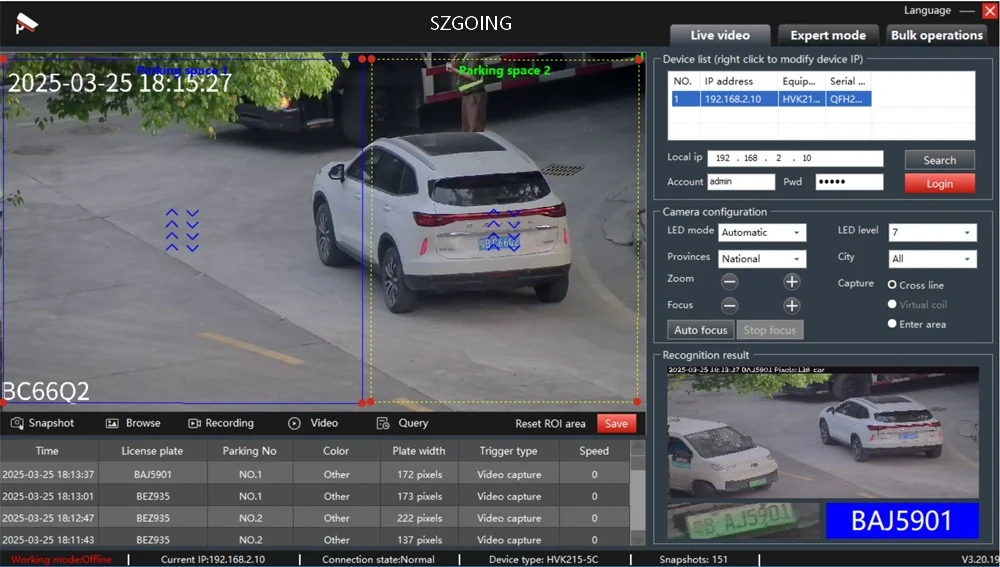
ANPR software showing a white electric car at a parking barrier at night with the plate BA5901 enlarged in a blue band
A barrier after dark: the plate is enlarged for the operator and the row is written before the car has stopped.
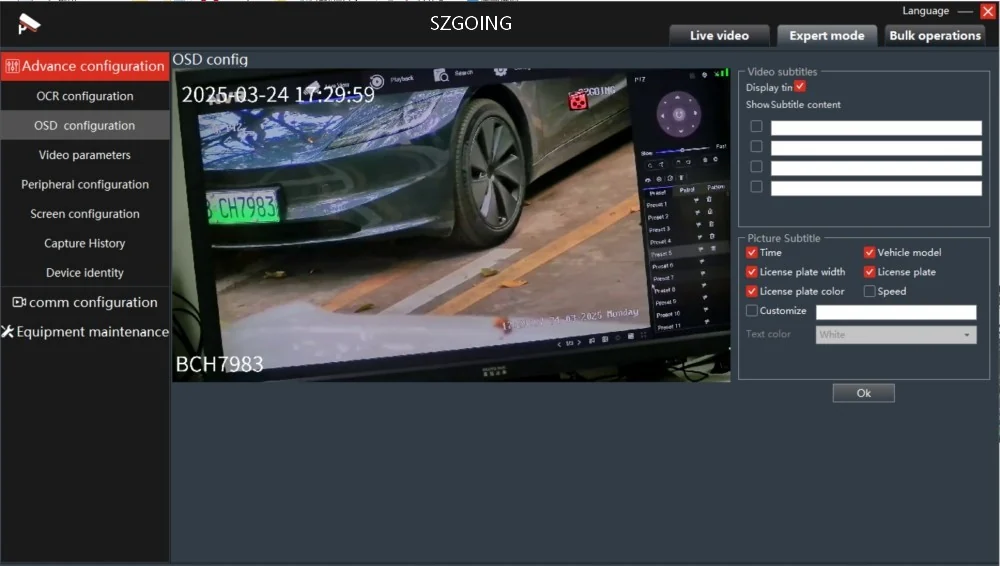
The camera's image settings panel with a live picture of a car on the left and exposure, gain and shutter controls on the right
Everything that has to be set once: exposure, gain, the fill lights and the trigger line, all in the browser.

The four things you configure, and then forget

A gate install is four decisions. The trigger line, drawn in the browser over the live picture. The fill light mode — 24 hours, a time window, or the light sensor, which is what most gates use. The relay dwell, so the barrier has time to lift before the contact releases. And the whitelist, which is a CSV rather than a database. Everything else ships at a sane default, and none of it needs a PC on site afterwards.

Who should not buy this

A site where the plate is read at 30 m, at speed, from a post that already has a cable: that is the 5 MP road head, and the difference is not marginal at that distance. A gate with no power: the solar tower carries this same head. And a barrier that already has a modern controller with its own ANPR input may only need the plate as a picture — in which case say so, and we will quote the cheaper site camera instead of a recogniser you will not use.

Three reasons a barrier is its own build

Six metres is a different optical problem

Between a post and a windscreen there are four to eight metres, and at 22 mm the frame at 6 m is 1.4 m wide — the plate, the windscreen and the driver's door, and nothing else. That tightness is why the 4 MP sensor is enough and why a 50 mm lens would be a handicap here: a long lens at six metres gives you a picture of one number.

The relay, not the cloud, opens the gate

The whitelist sits on the camera. A listed plate closes a dry contact for as long as you set; an unlisted one is captured, logged and, if you want, announced. Two RS485 ports cover controllers that expect a serial command instead of a contact, and the whole decision happens inside the housing — a dead uplink does not strand a resident at the barrier.

Every car leaves a row, even the ones you let through

The point of a barrier camera is often not security but the log: who came in, at what time, with what plate. Captures are written to the card as they happen — plate, timestamp, lane, JPEG — and the same records export as a report. 128 GB is tens of thousands of entries, which for a yard with two hundred movements a day is months, not days.

Questions

Questions

My post is 30 m from the barrier — is this still the right camera?

It will read at 30 m, but the plate is only 147 pixels wide there, and the honest answer is that the 5 MP build is the better camera at that distance because 50 mm of glass beats 22. This one is at its best between four and fifteen metres, which is where a barrier, a weighbridge or a yard entrance normally sits. Measure the distance and we will tell you which of the two to buy rather than sell you the dearer one.

Can residents' plates be whitelisted?

Yes — the list lives on the camera and takes number, colour and type, so a white plate and a yellow plate with the same characters are not the same entry. The relay closes only for a match, and everything else is captured anyway, so a refused entry is a picture with a time on it rather than a conversation with a guard.

What if the car stops on the trigger line?

Use the virtual loop rather than a ground coil: draw the line in the browser, and the camera captures when the plate crosses it in either direction. A car that stops on the line is still captured when it moves off, and a car that never crosses is still in the record because the video recognition writes a row whenever it reads a plate in the frame.

Does it handle two-line plates and unusual fonts?

It recognises more than 100 countries' plates with no training, and it improves: above 90% cold, above 99% after it has learned the site's own traffic. Two-line plates and heavy fonts are where cold-start figures vary most, so if that is what your country issues, send a photograph of a plate at the gate — we will run it before you order instead of after.

How does it get power at a barrier?

A single 12 V DC tail. Most barrier cabinets already have 12 or 24 V inside for the loop detector; where they do not, a small DIN supply in the cabinet is the usual answer. If there is no power at the post at all, take the solar tower — same head, 200 W of panel and a 1 TB recorder.

Quote a GT-LPR40M-50

Tell us the distance from the post to the plate, what the barrier controller expects (a contact or a serial command), and how many vehicles a day. You get the relay wiring and a delivered price.