
The layout, and why the count does not match
Look at the front of the housing and the geometry is simple: a crossbar with a fixed lens at its centre and a ball at each end, and a pan-tilt head hanging below the centre carrying two lenses side by side. Five lenses. The app shows four pictures, and the supplier prints "5-Lens | 4-Image" on its own artwork — the twin lens in the head is one channel, the same trick as the 120° + 60° pairing on the dual-lens AOV build. Four channels at 5 MP each is 20 MP, which is the number in the title.
| Channel | Lens | Mount | Moves? |
|---|---|---|---|
| 1 | Centre, fixed | Crossbar, front | No |
| 2 | Left ball | Crossbar, left | No |
| 3 | Right ball | Crossbar, right | No |
| 4 | Twin lens | PTZ head below | Yes, 350° |
| — | Not a channel | — | The second lens in the twin head |
That last row is the part worth reading twice. Only one of the five lenses can be aimed; the other four are set at installation and stay where they were pointed. Which means the mounting angle is the job: get the crossbar square to the yard and the three fixed views do the work, and leave the head for whatever moves.
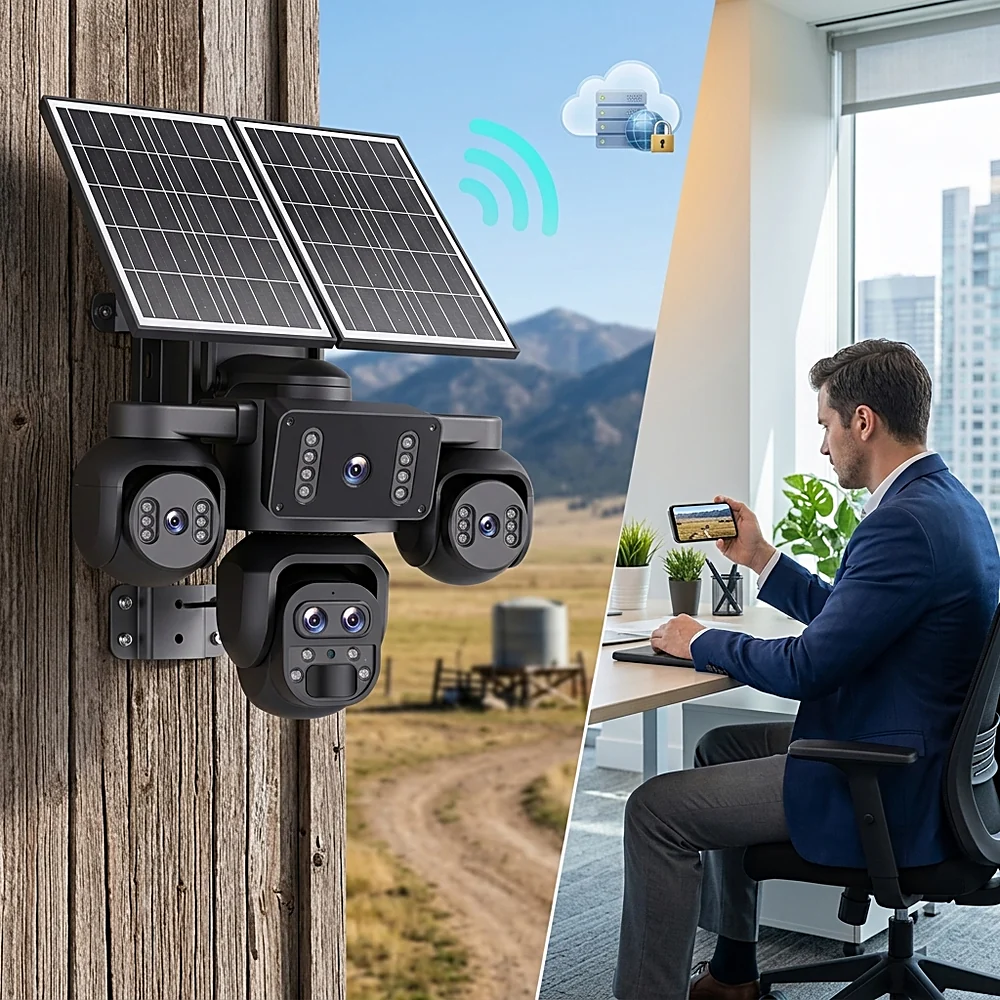
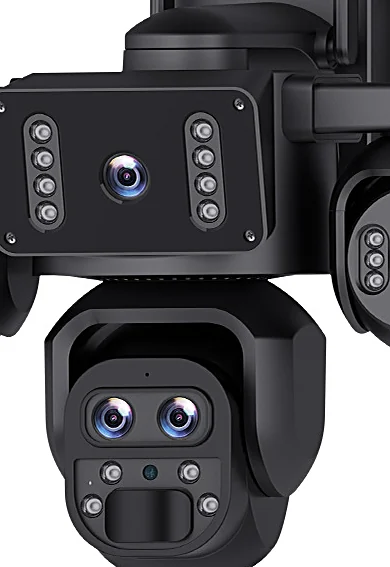
One pole instead of four
Four single-lens solar cameras on four corners of the same yard means four panels, four batteries, four SIM contracts and four entries in an app. This replaces that with one clamp, one pair of panels, one SIM and one entry — which is why the price reads low for what the picture count suggests. The cost is concentration: one radio now carries four streams, one card holds four recordings, and one failure takes four views down. On a yard where the four angles matter equally, that is a good trade; on a perimeter where you would rather lose one view than four, buy two of these or four separate cameras.
- One 4G radio, four streams: the encoder trades detail for frame rate
- One memory card holding four channels — size it for four, not one
- One housing, one failure: four pictures go dark together
- Fixed lenses do not re-aim themselves; the mount is the configuration
AOV, read from the supplier's own diagram
The fifth description image is a timeline comparison, and it is the most useful thing on the listing. When something moves, this camera records full frames; when nothing moves it keeps recording at a low frame rate — a few frames, not a black gap. The ordinary low-power camera in the other half of that diagram sleeps and records nothing at all until it is triggered. So AOV here means the record is continuous in time and sparse in frames, which is exactly what makes a card and a panel last a month. It is not full-rate video for 24 hours, and no solar camera at this price is.
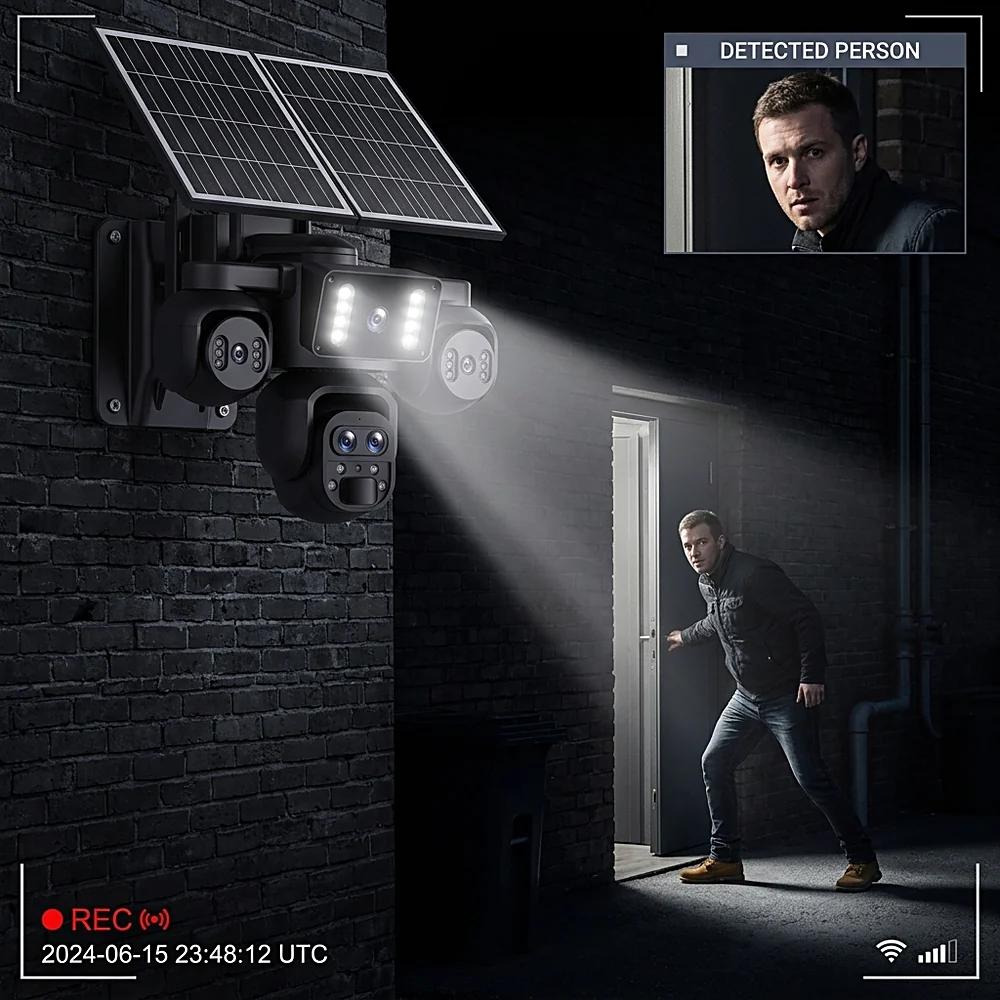
Three numbers the listing does not print
Battery capacity, panel wattage and standby draw are all missing, and without them the only honest statement about runtime is that it depends on your latitude and on how often someone opens the app. The same listing also gives 20 MP as a total and 5 MP + 5 MP + 5 MP + 5 MP as the option, which is consistent — but it means any comparison against a single 4K camera is meaningless: this is four modest sensors, not one sharp one. Ask us for the pack drawing, the panel rating and the firmware build on your batch; those three questions decide whether it works on your site, and none of them are on the page you just read.